
AI-Ready WordPress Architecture: How to Prepare Your Website for AI Search
Performance & SEO WordPress Development


Search is changing.
People are no longer relying only on short keyword queries to find information. They increasingly ask complex questions, compare solutions, and use AI-powered search experiences to discover companies, products, services, and expertise.
Google’s AI Overviews and AI Mode are part of this shift, alongside systems such as ChatGPT, Gemini, Claude, and Perplexity.
But this does not mean traditional SEO is disappearing.
The fundamentals still matter. Pages need to be accessible to search engines, indexable, useful, well structured, and connected through meaningful internal links.
What is changing is the importance of how information is organized and connected.
For WordPress websites, especially large and content-heavy platforms, this raises a new question:
Can your website’s architecture help both search engines and AI systems understand what your business does, how your content is related, and where the evidence for your expertise can be found?
That is what an AI-ready WordPress architecture is really about.
It is not about adding an AI chatbot.
It is not about generating thousands of pages with AI.
And it does not automatically mean moving to Headless WordPress.
It starts with the architecture underneath the content.
What Does “AI-Ready WordPress” Actually Mean?
The term AI-ready WordPress can sound more complicated than it is.
An AI-ready website is essentially a website where important information is:
- clearly structured
- logically connected
- technically accessible
- internally linked
- consistently described
- supported by structured data
- backed by real expertise and evidence
Think about the difference between two websites.
Website A
It has hundreds of pages about WordPress, development, integrations, performance, and AI.
But the pages are mostly isolated.
Website B
It has fewer pages, but they are connected:
WordPress Development
→ AI Search
→ Technical SEO
→ Headless Architecture
→ Performance
→ Integrations
→ Case Studies
The second website gives both users and search systems much more context.
The content does not simply exist.
It has relationships.
That distinction becomes increasingly important as search systems move from matching individual queries with individual pages toward understanding broader topics, entities, and relationships.
Why AI Search Makes Website Architecture More Important
Traditional search can often be simplified as:
Query → Page → Result
AI-powered search can involve a much broader process.
A user might ask:
“What WordPress architecture would work best for a 20,000-page media platform that needs fast performance, complex integrations, and strong SEO?”
There may not be one page on the internet that answers the entire question.
Instead, an AI system may need to understand several concepts:
- WordPress
- enterprise-scale content
- media platforms
- Headless architecture
- performance
- SEO
- APIs
- structured content
It then needs to identify relevant sources and connect those concepts into an answer.
This changes the role of a website.
A strong website should not only answer individual questions.
It should make the relationships between related information clear.
That is an information architecture problem.
And WordPress is particularly interesting here because it can be used as both a traditional publishing platform and a structured content layer for much more complex digital products.
AI Search Starts With Content Architecture
Before thinking about AI crawlers, AI-generated content, or new technical files, look at the content model.
A well-structured WordPress website should reflect the way the business actually operates.
For example, a technology company might have:
Services
- WordPress Development
- Headless WordPress
- Performance Optimization
- AI Search Optimization
- CRM Integrations
Industries
- SaaS
- Real Estate
- Media
- E-commerce
Use Cases
- Legacy Migration
- AI Search
- Performance Rescue
- API Integration
Evidence
- Case Studies
- Technical Guides
- Research
- Client Results
These are not just categories.
They are relationships.
A service can be relevant to an industry.
An industry can have multiple use cases.
A use case can be demonstrated through a case study.
A case study can use several technologies.
A technical article can explain the technology behind the implementation.
The result is a content system rather than a collection of pages.
DreamDev works with complex WordPress platforms where architecture, custom functionality, integrations, and scalability need to be considered together. Explore our Custom and Complex WordPress Development Solutions to see how this approach applies to technically demanding projects.
The 6 Layers of an AI-Ready WordPress Architecture
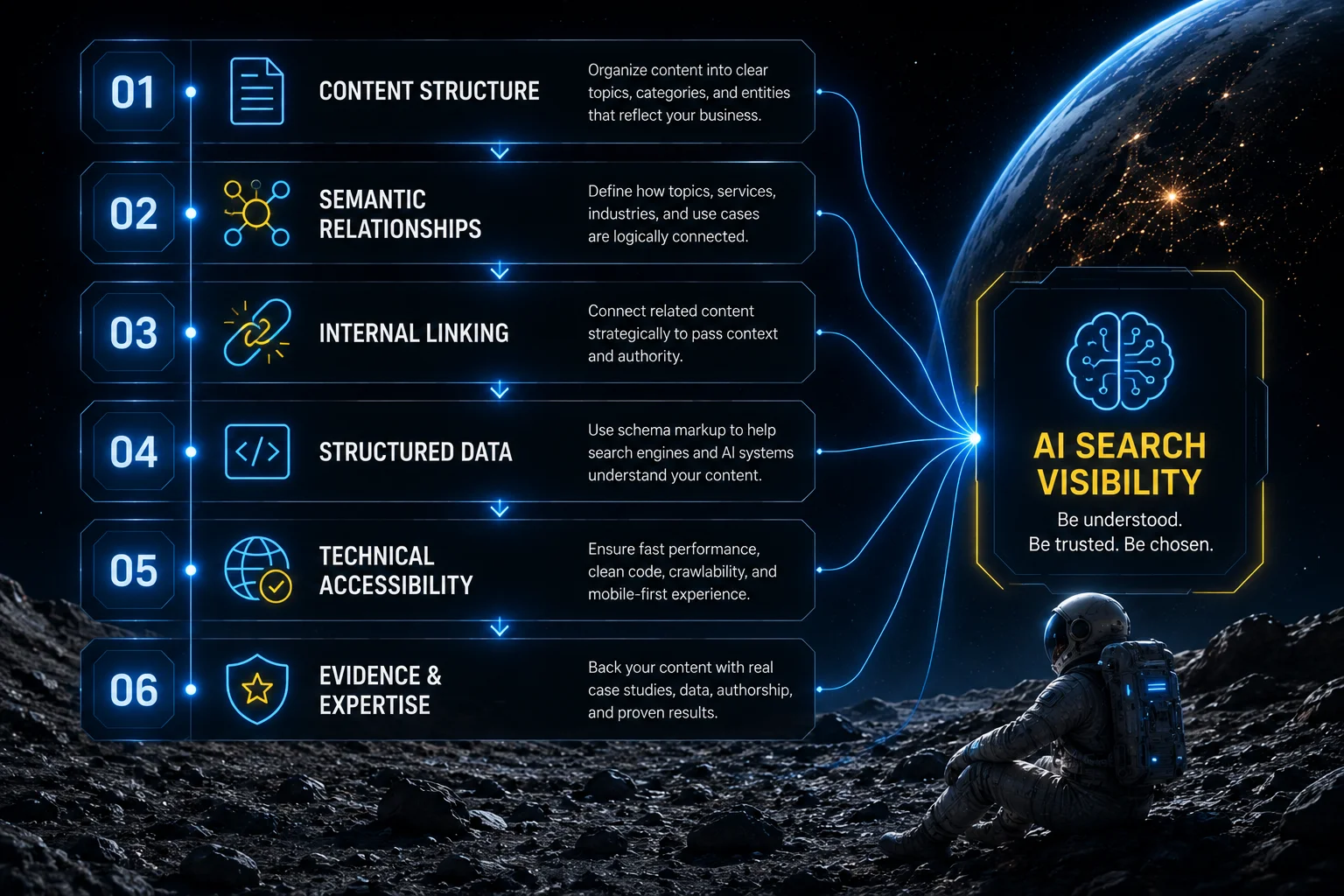
A useful way to think about AI readiness is as six connected layers.
1. Content Structure
The first layer is the content model itself.
Important concepts should have clear representations in WordPress.
Depending on the project, this might involve:
- Custom Post Types
- taxonomies
- custom fields
- reusable components
- structured relationships
- editorial workflows
The goal is not to make the CMS more complicated.
The goal is to make the content easier to manage and connect.
This becomes particularly important when a website grows from hundreds to thousands of pages.
2. Semantic Relationships
Content structure tells WordPress what different pieces of content are.
Semantic relationships explain how those pieces relate to each other.
Consider:
Headless WordPress
→ API architecture
→ WPGraphQL
→ Next.js
→ performance
→ SEO
→ media platforms
Those relationships create context around the topic.
This is also why simply creating dozens of keyword-focused pages can be counterproductive.
If several pages answer essentially the same question, they may create a fragmented content experience rather than stronger topical coverage.
A better approach is to build comprehensive resources around meaningful entities and topics and connect them to supporting content.
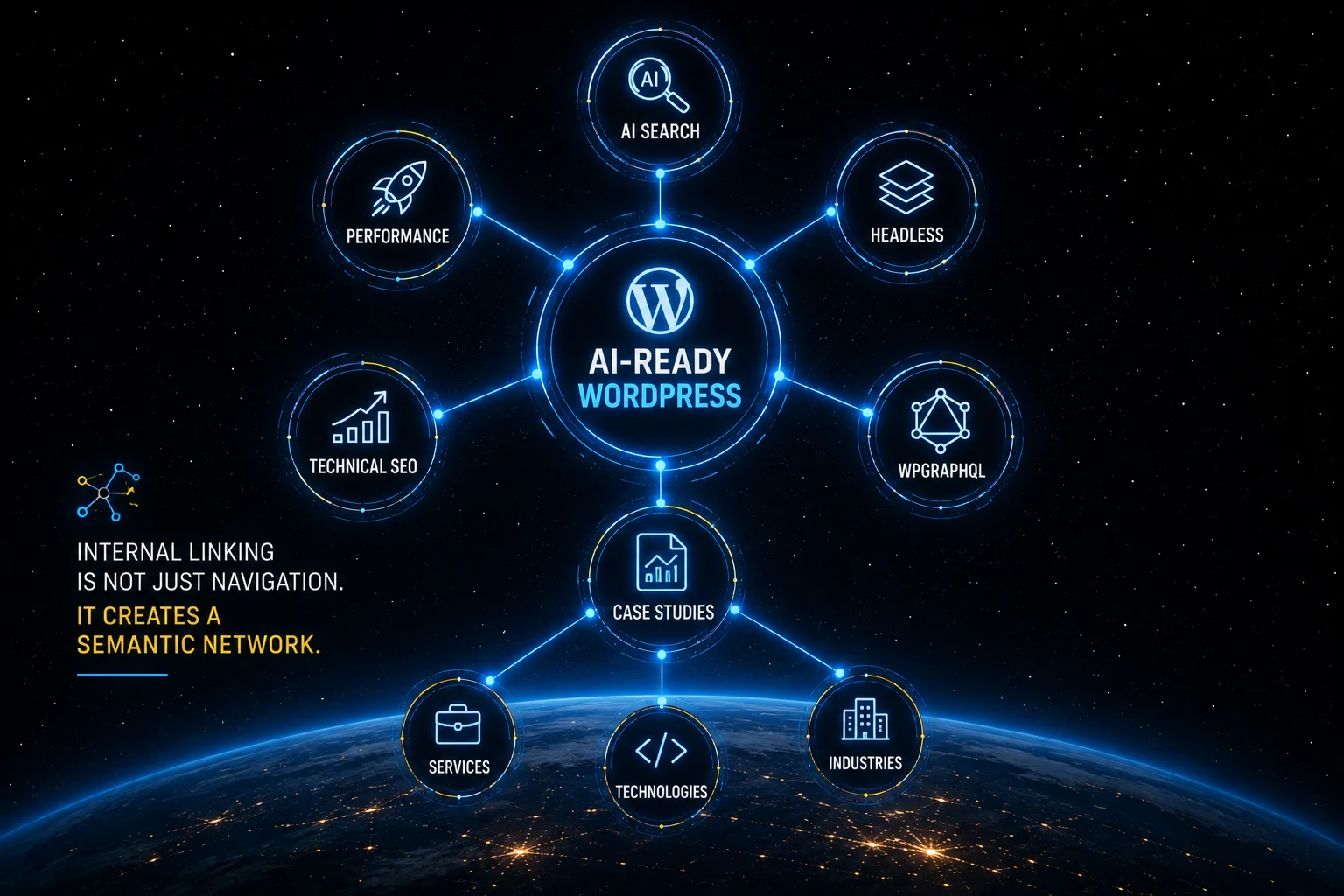
3. Internal Linking as a Semantic Layer
Internal linking is often treated as a technical SEO task.
For large WordPress websites, it should be treated as part of the information architecture.
A link does more than help a crawler discover another URL.
Contextual links can communicate that two pieces of information are related.
For example:
AI Search
→ AI Search case study
AI Search
→ Technical SEO
AI Search
→ Content Architecture
AI Search
→ Headless WordPress
AI Search
→ WordPress Performance
This creates a network of related information.
It also creates a better experience for users.
If someone is reading about AI search architecture, they may naturally want to understand how Headless WordPress works, whether performance affects the architecture, how APIs deliver structured content, or what a real AI search implementation looks like.
Those should not be dead ends.
They should be connected to relevant resources.
For example, DreamDev’s WPGraphQL vs REST API guide explains how API architecture affects complex Headless WordPress projects.
4. Structured Data Reinforces Meaning
Structured data is another layer of the architecture.
It can help search engines understand what a page represents and which entities are described on it.
Depending on the website, relevant structured data may include:
- Organization
- Article
- Service
- Person
- Breadcrumb
- Product
- LocalBusiness
- WebSite
But structured data should not be treated as a collection of Schema types to add for the sake of adding them.
It should reinforce the information already visible on the page.
If a page describes a service, the structured data should accurately represent that service.
If a page describes an organization, the organization information should be consistent.
If a page is an article, its author, title, dates, and other relevant properties should accurately reflect the visible content.
The goal is consistent machine-readable context, not Schema markup for its own sake.
5. Technical Accessibility Still Matters
AI search does not make technical SEO less important.
It makes a clean technical foundation even more valuable.
If important content cannot be crawled or indexed, it is difficult for any search system to use it.
For WordPress websites, an AI-readiness audit should therefore include:
- crawlability
- indexability
- canonical URLs
- XML sitemaps
- robots.txt
- redirects
- HTTP status codes
- JavaScript rendering
- internal links
- pagination
- faceted navigation
- duplicate URLs
- structured data
- Core Web Vitals
Large WordPress websites can accumulate technical debt quickly.
Thousands of automatically generated URLs, old redirects, duplicate taxonomies, inconsistent canonicals, or JavaScript-dependent content can make an otherwise valuable content library difficult to discover.
This is why AI optimization should not be separated from technical SEO.
The foundation still comes first.
DreamDev’s WordPress Speed Optimization guide covers the performance side of this foundation, including caching, asset optimization, Core Web Vitals, and situations where deeper architectural work may be required.
6. Evidence and Expertise Complete the Architecture
There is another layer that technical optimization cannot create by itself:
evidence.
A company can publish an article explaining how to build a Headless WordPress website.
That is useful.
But a case study showing that the company actually built a complex Headless WordPress platform provides a different kind of information.
This creates a relationship:
Service
→ what you offer
Technical content
→ what you know
Case study
→ what you have done
Result
→ what changed
This is one reason real project experience should be an important part of an AI-ready content strategy.
For example, DreamDev’s Headless WordPress Sports Media Platform case study describes a real platform combining WordPress, Next.js, API-driven content delivery, SEO, and a scalable editorial workflow.
The article you are reading should not replace that case study.
It should connect to it.
The case study provides evidence.
This article provides context.
A Real Example: Preparing WordPress for AI-Powered Search
The principles above are not theoretical.
DreamDev recently worked on a WordPress project specifically focused on preparing an existing website for AI-powered search.
The website already had valuable service pages and case studies.
The challenge was that the site had been designed primarily around traditional search.
The goal was to strengthen its foundation for the way people increasingly discover information through AI-powered systems.
The work included:
- semantic structure
- Schema.org
- internal linking
- technical SEO
- AI crawler accessibility
- robots.txt
- XML sitemap validation
- llms.txt
The important part was that the project did not rely on a large-scale content generation strategy.
The focus was on improving the existing website’s structure and making important information easier to discover, interpret, and connect.
You can see the implementation in the full AI-Powered Search for WordPress Website case study.
This leads to an important conclusion:
AI search optimization is not something you simply install. It is something you build into the website’s information architecture.
Do You Need Headless WordPress for AI Search?
No.
AI-ready WordPress does not automatically mean Headless WordPress.
Headless architecture solves a different class of problems.
It can be valuable when a project requires:
- highly customized frontends
- multiple digital channels
- API-driven content delivery
- advanced performance requirements
- complex applications
- independent frontend and backend development
- large media platforms
But a traditional WordPress architecture can also be highly effective when it is properly engineered.
The decision should be based on business and technical requirements rather than the assumption that Headless is inherently more modern.
DreamDev’s Headless WordPress Development service covers the architectural side of this decision, including Next.js, React, APIs, performance, SEO, and multi-channel content delivery.
For a deeper comparison, see Headless WordPress vs Traditional WordPress, which looks at performance, SEO, editorial workflows, scalability, development resources, and total cost of ownership.
AI-Ready Does Not Mean AI-Generated
One of the biggest misconceptions about AI search is that the answer must be more AI-generated content.
For enterprise websites, the opposite can often be more valuable.
AI can help teams understand and organize existing information.
For example, AI can assist with:
- content classification
- entity extraction
- content gap analysis
- internal link discovery
- duplicate-content detection
- metadata generation
- content audits
- topic clustering
- editorial research
This makes AI useful as an information operations layer.
Imagine a website with 15,000 pages.
A human team may struggle to identify:
- which pages describe the same concept
- which case studies support which services
- which important pages are orphaned
- where terminology is inconsistent
- where content overlaps
- which topics have strong evidence but weak internal connections
AI can help analyze that content at scale.
But the final goal is not to generate more pages.
It is to make the existing knowledge base clearer, more connected, and more useful.
What About llms.txt?
llms.txt has become one of the more visible concepts in AI-oriented website optimization.
It can be included in an AI-readiness strategy, particularly when a website wants to provide a curated representation of important resources.
But it should be treated as an additional layer, not the foundation.
An llms.txt file cannot fix:
- poor information architecture
- weak internal linking
- inaccessible content
- duplicate URLs
- bad canonicalization
- low-quality content
- unclear terminology
If the underlying website is difficult to understand, adding another file will not solve the architectural problem.
The better approach is:
Fix the website first.
Then consider additional machine-readable resources where they make sense.
Traditional SEO vs AI Search
The relationship between SEO and AI search is often misunderstood.
AI search does not make traditional SEO irrelevant.
Instead, some of the same fundamentals become useful in a broader discovery environment.
| Traditional SEO | AI Search |
| Target relevant queries | Answer complex questions |
| Optimize individual pages | Build connected information systems |
| Focus on rankings | Focus on visibility and retrieval |
| Internal links support discovery | Internal links also communicate relationships |
| Structured data supports understanding | Structured data reinforces entities and context |
| Build topical authority | Demonstrate expertise through connected evidence |
| Optimize snippets | Make information easy to retrieve and interpret |
| Create content around keywords | Create useful resources around topics and entities |
The practical lesson is simple:
Do not replace SEO with AI optimization. Build an architecture that supports both.
How to Audit a WordPress Website for AI Search
You do not need to rebuild your website to start.
Begin with an audit.
1. Audit the Content Model
Identify your core:
- services
- products
- industries
- technologies
- use cases
- case studies
- resources
Then identify which relationships are missing.
2. Map Your Content Relationships
Ask:
Which case studies prove each service?
Which articles explain each technology?
Which services solve each use case?
Which industries are connected to each solution?
This creates the foundation for a semantic content map.
3. Audit Internal Links
Look for:
- orphan pages
- isolated case studies
- commercial pages without supporting content
- articles without links to relevant services
- duplicate content clusters
- important pages buried deep in the site
The goal is not to maximize the number of links.
The goal is to make important relationships obvious.
4. Audit Technical Accessibility
Review:
- robots.txt
- XML sitemap
- canonical URLs
- redirects
- indexability
- rendering
- status codes
- JavaScript dependencies
- URL parameters
- duplicate URLs
A strong content strategy cannot compensate for inaccessible content.
5. Audit Structured Data
Check whether important entities are represented consistently and whether structured data accurately reflects the visible content.
6. Audit AI Search Visibility
Go beyond:
“What keywords do we rank for?”
Ask:
- Is our company clearly identifiable?
- Are our services clearly defined?
- Are our areas of expertise connected?
- Are our claims supported by evidence?
- Are our case studies connected to relevant services?
- Can important information be retrieved from accessible pages?
- Does the website provide enough context to answer complex questions?
This is where traditional SEO auditing begins to overlap with AI search readiness.
A Practical AI-Ready WordPress Architecture
The entire approach can be summarized as a layered system:
Business Entities
↓
Content Model
↓
Semantic Relationships
↓
Internal Linking
↓
Structured Data
↓
Technical Accessibility
↓
Evidence & Expertise
↓
AI Search Visibility
AI is not the first layer.
It is what the entire system is designed to support.
This is why adding an AI plugin to a poorly structured WordPress website rarely solves the real problem.
The better question is:
Can the website’s existing information be understood, connected, retrieved, and trusted?
If the answer is yes, AI becomes another way for people to discover that information.
What This Means for Large WordPress Websites
The larger the website, the more important this becomes.
A 30-page company website can often survive a relatively simple content structure.
A 10,000-page website cannot rely on users or search engines manually reconstructing its relationships.
At scale, architecture becomes part of SEO.
And as AI-powered discovery grows, architecture also becomes part of AI visibility.
This is why enterprise WordPress projects should consider content architecture at the same level as:
- performance
- security
- integrations
- scalability
- SEO
- accessibility
It is not a marketing layer added after development.
It is part of the platform itself.
DreamDev works with large and technically complex WordPress platforms, including projects involving large content libraries, custom integrations, performance optimization, migrations, and Headless architectures. Explore our Custom and Complex WordPress Development Solutions.
The Future of WordPress Search Is Connected Information
The future of AI search is not about creating more content for machines.
It is about creating better information systems for people and machines.
A strong WordPress website should make it easy to understand:
Who you are
What you offer
Who you serve
What technologies you use
Which problems you solve
What evidence supports your expertise
How all of that information is connected
That requires more than keywords.
It requires architecture.
It requires semantic relationships.
It requires internal linking.
It requires technical accessibility.
And it requires real evidence.
AI can then become another layer through which people discover that knowledge.
Final Takeaway
AI search is changing how websites are discovered, but it does not invalidate the foundations of SEO.
For WordPress, the opportunity is to build those foundations more intelligently.
An AI-ready architecture connects:
Content → Structure → Relationships → Internal Links → Structured Data → Technical SEO → Evidence → AI Search
You do not need to turn every WordPress website into a Headless application.
You do not need to publish thousands of AI-generated articles.
And you do not need to chase every new AI optimization tactic.
Start with the architecture.
Make your information clear.
Connect related knowledge.
Make important content technically accessible.
Support your expertise with real evidence.
Then your WordPress website is not only optimized for today’s search.
It is prepared for how people will discover information next.
Frequently Asked Questions
What is an AI-ready WordPress website?
An AI-ready WordPress website has a clear content architecture, meaningful relationships between pages, strong internal linking, accurate structured data, accessible content, and evidence of expertise. The goal is to make important information understandable to both people and AI-powered search systems.
How do I optimize WordPress for AI search?
Start with the fundamentals: improve information architecture, strengthen internal linking, make content crawlable and indexable, implement accurate structured data, organize content around meaningful entities and topics, and connect claims with real evidence such as case studies and original research.
Does AI search replace traditional SEO?
No. AI-powered search still relies on many of the same foundations as traditional search, including accessible content, crawlability, indexability, useful information, internal linking, and structured data.
Does Headless WordPress improve AI search visibility?
Not automatically. Headless WordPress can provide benefits for performance, frontend flexibility, APIs, and multi-channel content delivery, but AI search visibility depends on the quality of the overall implementation and content architecture.
Does WordPress need llms.txt for AI search?
No. llms.txt should not be treated as a replacement for technical SEO or content architecture. It can be considered as part of a broader AI-readiness strategy, but the underlying website remains more important.
Can AI-generated content improve AI search visibility?
AI can support research, content analysis, classification, metadata, and editorial workflows. However, simply generating large quantities of content does not create authority or guarantee visibility in AI search.
Why is internal linking important for AI search?
Internal links help search engines discover pages and understand how content is connected. On a large website, contextual links can also reinforce relationships between services, technologies, use cases, case studies, and supporting resources.
Does an enterprise WordPress website need an AI rebuild?
Not necessarily. Many existing WordPress websites can become significantly more AI-ready through improvements to content architecture, internal linking, structured data, technical SEO, and content organization without replacing the entire platform.
-
 WordPress Development
 What Happens After a WordPress Website Goes Live? The Work Nobody Plans For
From CRM integrations and plugin updates to technical debt and new business requirements, discover the work that keeps a growing WordPress website moving after launch.
18.08.2026 -
WordPress Development
Taking Over an Existing WordPress Website: A Technical Guide for Agencies
Taking over an existing WordPress website? This technical guide helps agencies assess infrastructure, code, security, integrations, SEO, performance, and technical risks before accepting responsibi...
18.08.2026 -
WordPress Development
How to Handle WordPress Development Overflow Without Hiring
Learn how to handle WordPress development overflow, add flexible capacity, and take on more projects without rushing into a full-time hire.
18.08.2026