
How to Handle WordPress Development Overflow Without Hiring
WordPress Development Overflow: Scale Without Hiring
WordPress Development


Your agency has more WordPress work than your development team can comfortably handle.
That is a good problem to have.
Until deadlines start slipping, developers are switching between projects, and your PMs are trying to figure out which client needs attention first.
Hiring another developer might solve the problem. But what if the extra workload comes from two large projects landing at the same time? Or one technically demanding client? Or a temporary gap while you recruit?
You do not necessarily have a hiring problem.
You may have a capacity problem.
And those are not the same thing.
First, work out what kind of capacity problem you have
Before adding another developer, look at what is actually putting pressure on your team.
Scenario 1: You have a temporary workload spike
Your team normally has enough capacity, but several projects have entered development at once.
For example:
- two website launches overlap
- an existing client adds a large feature set
- a new project starts before another one is finished
- a seasonal campaign creates a temporary increase in demand
Hiring a full-time developer for a three-month spike may not make much sense.
Scenario 2: You have a specialist skills gap
Your team has enough developers, but a particular project needs expertise you do not use every month.
That might be:
- complex WordPress architecture
- WooCommerce development
- CRM or API integrations
- performance optimization
- headless WordPress
- large-scale migrations
- inherited or poorly documented codebases
Adding another generalist developer will not necessarily solve a specialist problem.
Scenario 3: You have a permanent capacity problem
Your development calendar has been full for months.
New projects keep coming.
Existing clients need ongoing work.
Your pipeline looks strong enough to keep another developer busy for the foreseeable future.
That is different.
In this situation, hiring may be the right long-term decision.
External development support can still help while you recruit, but it should not become a permanent workaround for a structural staffing problem.
The key question
Instead of asking:
“Do we need another developer?”
Ask:
“Is this workload temporary, specialized, or permanent?”
That distinction makes the next decision much easier.
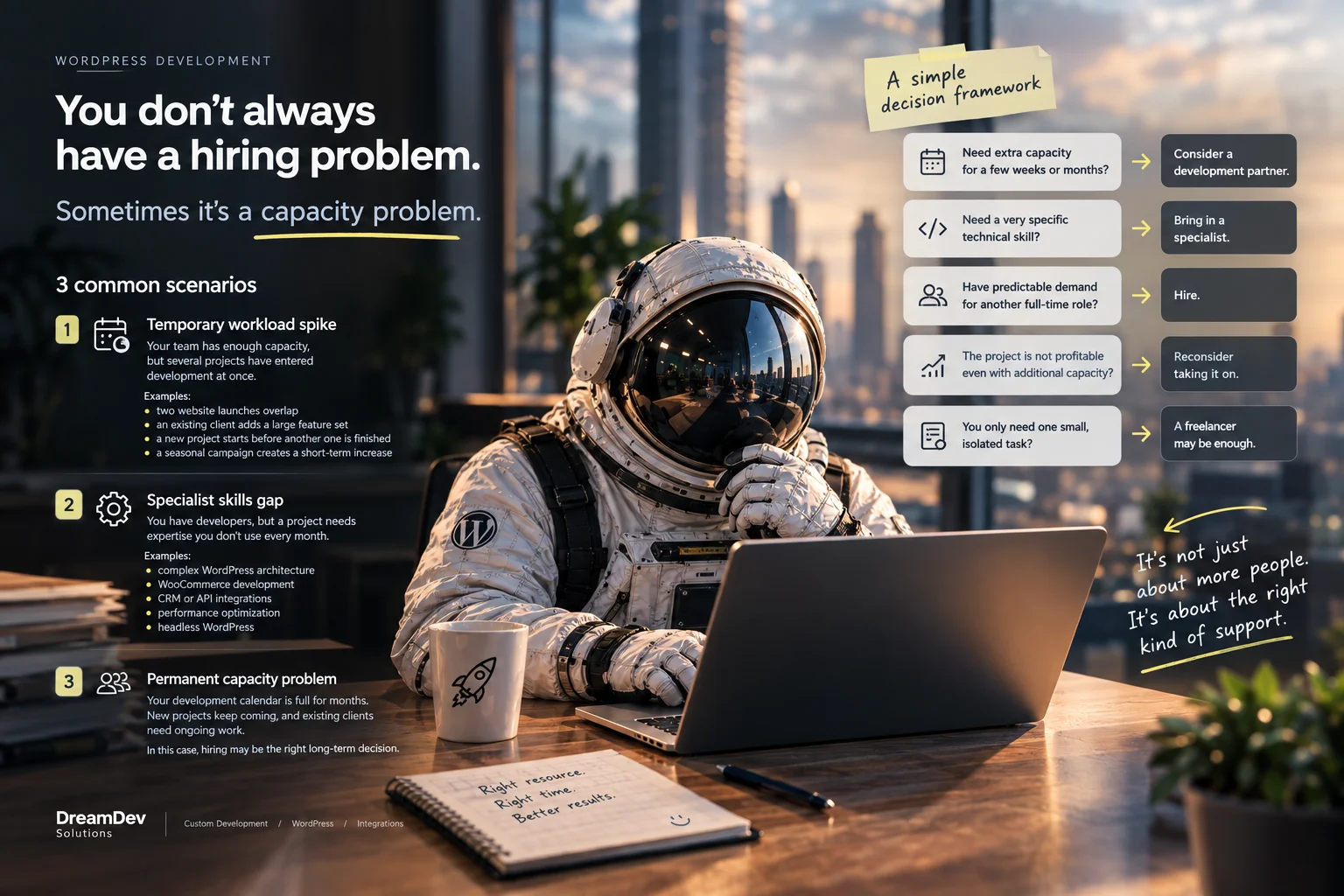
WordPress development capacity: how to decide between hiring, freelancers, specialists, and a development partner.
Four ways agencies deal with WordPress development overflow
Once you understand the problem, there are usually four options.
| Option | Makes sense when | The trade-off |
| Hire internally | Demand is predictable | Recruitment takes time and creates fixed capacity |
| Use freelancers | You need a defined task or short project | Availability and continuity can vary |
| Delay or decline work | Your team is already at its limit | You lose revenue or push client timelines |
| Work with a development partner | Demand fluctuates or specialist skills are needed | You need a partner who fits your process |
There is no universally correct answer.
The mistake is treating every temporary capacity gap as a reason to hire.
A simple decision framework
Need extra capacity for a few weeks or months?
→ Consider a development partner.
Need a very specific technical skill?
→ Bring in a specialist.
Have predictable demand for another full-time role?
→ Hire.
The project is not profitable even with additional capacity?
→ Reconsider taking it on.
You only need one small, isolated task?
→ A freelancer may be enough.
The point is not to avoid hiring.
It is to avoid making a permanent hiring decision to solve a temporary problem.
The hidden cost of saying yes when your team is already full
When a promising project comes in, the easiest answer is often:
“We can probably fit it in.”
Maybe you can.
But where does that extra capacity come from?
Usually, it comes from somewhere else.
A developer works later.
A different task gets postponed.
QA gets squeezed.
A senior developer starts jumping between projects.
The project still gets delivered, but the cost appears in places that are harder to measure.
Project margins get smaller
Context switching, overtime, rework, and rushed QA all consume time.
A project that looked profitable when it was sold can become much less attractive once the delivery team starts absorbing the overflow.
Senior developers become bottlenecks
One developer may be the only person who knows a particular codebase or integration.
Soon every difficult task waits for them.
PMs spend more time managing technical problems
Instead of managing the client relationship and project priorities, PMs start chasing developers, moving deadlines, and negotiating internal capacity.
New opportunities become harder to accept
Your sales team may have good opportunities in the pipeline, but nobody wants to promise a delivery date the development team cannot realistically meet.
The question is therefore not:
“Can we squeeze this project into the calendar?”
It is:
“Can we deliver it without disrupting everything else?”
That is a much better capacity test.
What should your agency keep in-house?
Adding external development capacity does not mean handing over the entire client relationship.
In many successful agency partnerships, the agency keeps ownership of the parts where its client knowledge and strategic expertise matter most.
Keep internally
- client relationships
- strategy
- account management
- UX and design direction
- scope and priorities
- project ownership
- final client communication
Consider external support for
- WordPress development
- custom themes and plugins
- WooCommerce development
- API and CRM integrations
- performance optimization
- migrations
- technical troubleshooting
- headless implementations
- complex or inherited WordPress codebases
This lets the agency add engineering capacity without giving up control of the project.
For technically demanding projects, Custom and Complex WordPress Development covers custom functionality, integrations, WooCommerce, migrations, enterprise architecture, and other advanced WordPress requirements.
Not every WordPress project needs the same expertise
This is one of the strongest arguments for flexible development capacity.
A marketing website might need a developer for several weeks.
A WooCommerce project may require someone comfortable with custom checkout flows, integrations, performance, and large product catalogs.
A large publishing platform can involve complex content architecture and high traffic.
A headless project may require experience across WordPress, APIs, and a separate frontend.
An agency does not necessarily need every one of these skills permanently in-house.
It needs access to the right expertise when the project requires it.
For example, Headless WordPress Development can be relevant when a project needs WordPress as a CMS while using a separate frontend and API layer.
The same applies to integrations. A project involving CRM data, webhooks, custom APIs, or business automation may require significantly more engineering than a standard WordPress implementation.
How to add development capacity without adding another management headache
This is where external partnerships often succeed or fail.
You solve the development bottleneck but create a coordination bottleneck instead.
Now there is another team to manage, another communication channel, and another process to explain to everyone.
That defeats the purpose.
A good overflow setup should make your agency more capable without making it more complicated.
1. Keep one clear owner
The agency should remain responsible for the client and the overall project.
The development partner works within that structure.
Your client should not suddenly have to figure out who is responsible for what.
2. Work inside your existing process
The partner should be able to work with the tools and workflows your team already uses.
That can include:
- project management
- Git
- staging environments
- communication tools
- QA processes
- development standards
The less you have to reorganize, the more useful the additional capacity becomes.
3. Start with a defined project
You do not need to commit to a long-term partnership immediately.
A defined project or technical task gives you a chance to evaluate:
- code quality
- communication
- reliability
- technical judgment
- QA
- ability to work with an existing codebase
- ability to meet agreed deadlines
If the collaboration works, it can grow naturally.
4. Make the technical handoff clear
External developers should not have to reverse-engineer a project from a vague Slack message.
A good handoff usually includes:
- requirements
- designs
- acceptance criteria
- existing documentation
- repository and staging access
- integrations and dependencies
- deadlines
- QA expectations
This is not bureaucracy.
It is how you prevent an extra development team from creating extra management work.
What to look for in a WordPress development partner
Technical expertise matters.
But for an agency, process fit matters just as much.
Before starting a partnership, ask:
Can they work with our workflow?
A good partner adapts to your tools, communication style, repositories, staging environments, and QA process.
Can they work with an existing codebase?
Most client projects are not clean greenfield builds.
You need developers who can understand someone else’s architecture, identify risks, and make changes without creating new problems.
Who handles QA?
If every piece of work comes back to your internal team for testing, you have not actually removed much workload.
Can they handle complex work?
The value of a technical partner becomes much greater when a project moves beyond standard page implementation.
That might mean custom functionality, integrations, performance problems, migrations, WooCommerce, or architectural decisions.
Can they work behind the scenes?
The client relationship belongs to your agency.
The development partner should understand that their role is to strengthen your delivery, not compete with it.
Can capacity scale with your workload?
Your agency may need significant development capacity this month and very little next month.
A useful partnership should be able to accommodate that reality.
What agencies often get wrong
There is one more issue worth considering.
When agencies first look for additional development capacity, they often focus almost entirely on hourly rates.
That is understandable.
But the cheaper developer is not necessarily the cheaper option.
Consider what happens if:
- the developer needs constant clarification
- your PM has to review every task
- QA comes back to your internal team
- deadlines are missed
- the code needs to be rewritten
- nobody wants to touch the project after launch
The hourly rate may look attractive.
The actual cost of delivery may not be.
For an agency, a better question is:
How much management and delivery risk does this partner remove?
That is where a strong technical partnership starts to pay for itself.
A real-world way to test the partnership
You do not need to hand over your biggest client project on day one.
Start with something where the expectations are clear.
For example:
Situation: Your internal team has three active WordPress projects and another client needs a complex integration.
Instead of: Pulling your senior developer away from an existing project.
Try: Give the external team the integration as a defined workstream with clear requirements, access, acceptance criteria, and a deadline.
Then evaluate the result.
Did the team understand the codebase?
Did they communicate risks early?
Did the work pass QA?
Did your PM have to spend more time managing them or less?
Could you confidently give them a larger workstream next time?
That tells you far more than a sales call ever will.
When overflow becomes a long-term advantage
Development overflow is often treated as a problem that agencies need to eliminate.
It can also become a way to make the business more flexible.
You can accept a project without immediately hiring.
You can take on technically demanding work without keeping every specialist on payroll.
You can protect your internal developers from constant context switching.
And when demand changes, your development capacity can change with it.
The goal is not to outsource your agency.
It is to make sure development capacity does not become the reason you have to say no to good work.
At DreamDev, we work with agencies as an extension of their delivery teams, supporting complex WordPress development, integrations, WooCommerce, performance work, migrations, headless projects, and ongoing technical delivery.
If your agency has more WordPress work in the pipeline than your internal team can comfortably handle, see how WordPress Support for Agencies can extend your development capacity without changing who owns the client relationship.
-
 Performance & SEO
 AI-Ready WordPress Architecture: How to Prepare Your Website for AI Search
Search is changing. People are no longer relying only on short keyword queries to find information. They increasingly ask complex questions, compare solutions, and use AI-powered search experiences...
15.09.2026 -
Business Analysis Insights
AI for WordPress: A Practical Guide to Smarter Websites, Automation, and AI Agents
Artificial intelligence is changing how businesses build, manage, and grow digital products. For WordPress websites, the shift goes far beyond AI-generated content or chatbots. Today’s AI solutio...
15.09.2026 -
WordPress Development
Headless WordPress vs Traditional WordPress
Discover the key differences between Traditional WordPress and Headless WordPress. Compare performance, SEO, development costs, scalability, and real-world use cases to determine which architecture...
15.09.2026