We worked with Aleksandr and his team on the complex tech SEO project for the WordPress site and I was truly impressed. At Dreamdev, they are not just about getting things somehow done, they are all about quality, solution-orientation and deliverability. Their expertise is top-notch and attention to detail is what makes them as an agency extra special. Communication was flawless, which also ensured us reaching all the goals we set for the project. Aleksandr himself asks for the in-between feedback making sure his team grows. Can’t recommend more!
AI-to-WordPress Development: Building a Scalable Website Production Workflow
A European web design and SEO agency wanted to speed up website production using AI-generated designs without compromising quality. While AI tools like Claude Code accelerated the initial design phase, the generated output still required professional WordPress engineering. The websites needed a scalable architecture, clean editing experience, strong performance, and a solid technical SEO foundation.
DreamDev built a repeatable AI-assisted WordPress workflow that transforms AI-generated concepts into production-ready websites, enabling faster delivery while maintaining consistent quality across projects.
-
Business Challenge
The agency wanted to increase delivery capacity without compromising website quality.
AI-generated layouts provided an excellent starting point, but the output required substantial engineering work before it could be used in production. The generated code lacked a scalable architecture, contained duplicated markup, inconsistent responsive behavior, and limited editing flexibility inside WordPress.
From a business perspective, every client website also needed to launch with a strong technical foundation. That included clean content management, search engine visibility, fast loading times, structured data, and an architecture that could be reused across future projects.
Rather than outsourcing individual WordPress builds, the agency needed a long-term engineering workflow that could scale alongside its business.
-
Our Engineering Process
Reviewing AI-Generated Output
Every project began with an engineering review rather than a direct import into WordPress.
The AI-generated layouts were analyzed to identify reusable interface patterns, normalize spacing and typography, simplify complex structures, and define a consistent content hierarchy before development started.
This planning phase reduced technical debt and established a clear foundation for future scalability.
Building a Modular WordPress Architecture
Instead of recreating static pages, we built a reusable component library inside WordPress.
Each section became an independent building block, including hero banners, service sections, feature grids, testimonials, FAQs, calls to action, contact forms, blog layouts, and portfolio templates.
Global styles controlled typography, colors, spacing, buttons, and responsive behavior across the website, allowing content editors to make updates while maintaining visual consistency.
Production-Ready Elementor Implementation
The frontend was rebuilt using clean Elementor architecture designed for long-term maintainability.
The implementation included:
- Global templates
- Theme Builder integration
- Reusable widgets
- Dynamic content support
- Responsive layouts
- Minimal DOM complexity
- Consistent spacing system
The result was a flexible editing experience that allowed non-technical users to manage content without affecting the design system.
Technical Highlights
Although AI accelerated the initial design process, production readiness depended on engineering best practices.
Our implementation focused on:
- Semantic HTML5 markup
- Accessible navigation structure
- Proper heading hierarchy
- Reusable design tokens
- Component-based page architecture
- Optimized CSS delivery
- Reduced JavaScript execution
- Responsive image handling
- Lazy loading
- Reduced DOM complexity
- Performance-focused frontend architecture
The website was designed for long-term maintenance rather than a one-time launch.
Technical SEO
Technical SEO was integrated throughout development rather than added after launch.
Key improvements included:
- Semantic page structure
- SEO-friendly URLs
- Optimized metadata
- Canonical URL strategy
- XML sitemap compatibility
- Internal linking structure
- Breadcrumb navigation
- Optimized image ALT attributes
- Open Graph metadata
- Mobile-first implementation
- Core Web Vitals optimization
Structured data was implemented using JSON-LD and Schema.org vocabulary, following the same semantic principles we apply in our Generative Engine Optimization (GEO) projects.
Depending on page type, the website included structured data for:
- Organization
- WebSite
- WebPage
- Service
- BreadcrumbList
- FAQPage
- Article
- ContactPage
This provided search engines with consistent machine-readable information while strengthening semantic relationships across the website.
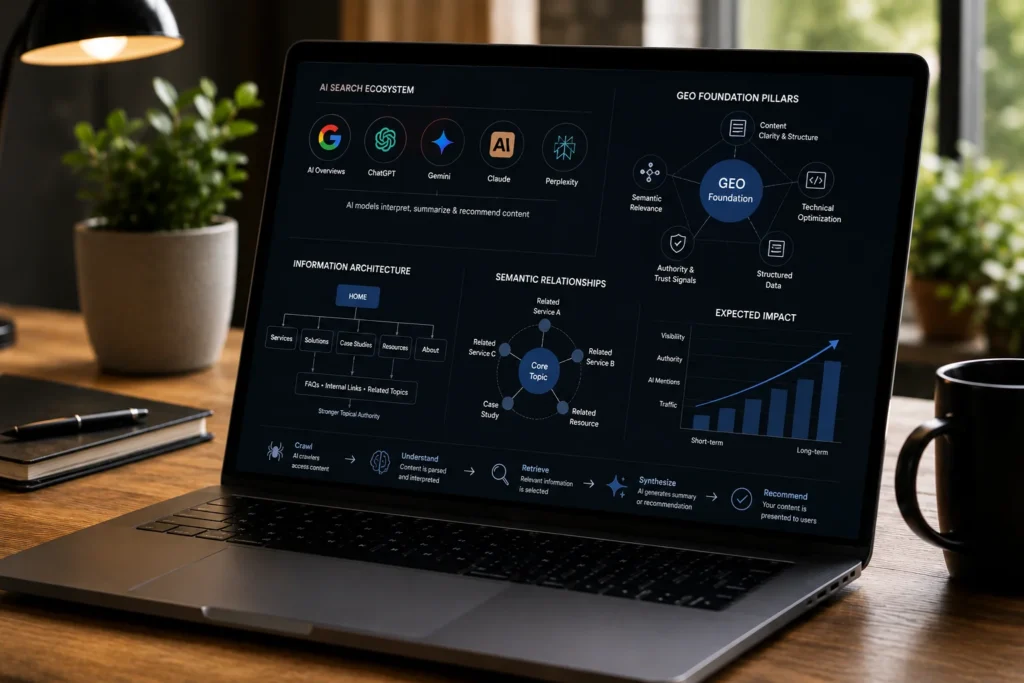
GEO Optimization for AI Search
Modern websites need to be understandable not only by traditional search engines but also by AI-powered search platforms.
To improve machine readability, we implemented a Generative Engine Optimization (GEO) strategy focused on semantic structure and entity relationships.
The implementation included:
- Semantic content organization
- Structured service descriptions
- Logical page hierarchy
- Entity-focused information architecture
- FAQ-ready content structure
- Contextual internal linking
- Consistent metadata
- llms.txt implementation
- Optimized robots.txt
- Schema.org enhancements
These improvements help AI systems interpret website content more accurately while supporting visibility across emerging AI-driven search experiences.
Performance Optimization
AI-generated frontend code often requires refinement before production deployment.
Performance optimization focused on:
- Removing redundant markup
- Optimizing CSS delivery
- Reducing JavaScript execution
- Image optimization
- Lazy loading
- Efficient asset loading
- Improved rendering performance
- Core Web Vitals improvements
The final implementation delivered a faster and more efficient website across desktop and mobile devices.
Scalable Website Production
One of the project’s primary objectives was enabling repeatable delivery.
Instead of building a single website, we created a reusable production framework that supports future client projects.
New websites can now reuse the same component library, templates, design system, SEO configuration, and page architecture while replacing only branding, imagery, and content.
This approach reduces production time while maintaining consistent quality and simplifying long-term maintenance.
-
Results
The completed project established a scalable workflow for converting AI-generated concepts into professional WordPress websites.
The agency now benefits from:
- A repeatable AI-assisted WordPress development workflow
- Fully editable WordPress websites
- Reusable Elementor components
- Consistent design systems across projects
- A strong technical SEO foundation
- AI-ready website architecture through GEO optimization
- Improved performance and Core Web Vitals
- Easier maintenance for future client websites
- Faster delivery of new projects using reusable templates and components. This workflow is particularly valuable for digital agencies looking for a reliable WordPress development partner capable of scaling website production.
Rather than treating AI as a replacement for developers, the project demonstrates how AI-assisted workflows and professional WordPress engineering can work together to deliver maintainable, scalable, and search-ready websites.
-
Why AI-Generated Websites Still Need WordPress Engineers
Artificial intelligence has changed how websites are designed and prototyped. Modern tools such as Claude Code, ChatGPT, v0, Cursor, and similar AI assistants can generate layouts, interface components, and frontend code within minutes.
For agencies, this significantly shortens the initial design phase.
However, generating a website is only the beginning.
Launching a production-ready WordPress website requires engineering decisions that extend far beyond visual design. Maintainability, performance, content management, accessibility, technical SEO, structured data, and long-term scalability remain challenges that require experienced WordPress developers.
AI is an effective accelerator, but it does not replace engineering.
From Prototype to Production
AI-generated code is typically optimized to demonstrate an idea rather than support years of maintenance.
Without engineering refinement, projects often include duplicated markup, inconsistent styling, accessibility issues, excessive DOM complexity, and limited flexibility for future updates.
Professional WordPress development services transforms those prototypes into reusable systems built around templates, components, dynamic content, and structured editing workflows.
Building for Editors, Not Developers
A successful WordPress project is more than a collection of pages.
Marketing teams should be able to update services, publish articles, change layouts, and manage content without modifying code.
By using reusable Elementor components, global templates, and consistent design tokens, the website becomes easier to maintain while preserving design consistency across every page.
Technical SEO Requires Engineering
Search engines evaluate far more than content alone.
A strong technical foundation includes semantic HTML, structured metadata, logical heading hierarchy, optimized internal linking, canonical URLs, XML sitemaps, image optimization, and structured data using JSON-LD.
Integrating these elements during development creates a website that is easier to crawl, understand, and maintain.
Preparing Websites for AI Search
Generative Engine Optimization (GEO) extends traditional SEO by improving how AI systems interpret website content.
Clear semantic relationships, structured service descriptions, Schema.org markup, entity-focused architecture, FAQ content, and machine-readable metadata all contribute to better understanding by AI-powered search platforms.
Building these elements into the website from the beginning creates a stronger foundation for future search experiences.
Engineering for Scale
Many agencies adopting AI-assisted development plan to launch dozens of websites each year.
A scalable production workflow depends on reusable components, standardized templates, consistent SEO configurations, and modular architecture rather than isolated page designs.
This makes future projects faster to deliver while maintaining quality and simplifying long-term support.
Combining AI with WordPress Engineering
The most effective workflow combines the speed of AI with the experience of WordPress engineers.
AI accelerates design and content generation, while engineering ensures maintainability, performance, accessibility, search visibility, and scalability.
That combination enables agencies to deliver websites more efficiently without compromising the standards expected from modern WordPress development.
Customer Testimonials
Here's what our customers say about DreamDev Solutions. Our clients appreciate our commitment to quality, efficiency, and innovation. With 40,000+ hours of hard work and a 93% returning customer rate, we have built long-term relationships based on trust and outstanding results.