We worked with Aleksandr and his team on the complex tech SEO project for the WordPress site and I was truly impressed. At Dreamdev, they are not just about getting things somehow done, they are all about quality, solution-orientation and deliverability. Their expertise is top-notch and attention to detail is what makes them as an agency extra special. Communication was flawless, which also ensured us reaching all the goals we set for the project. Aleksandr himself asks for the in-between feedback making sure his team grows. Can’t recommend more!
Enterprise AI Integration for WordPress: Building an AI-Powered Knowledge Platform
Enterprise AI Integration · RAG · AI Agents · WordPress · API Integration
-
What if your enterprise knowledge could actually work for you?
Enterprise organizations rarely have a shortage of information.
They have the opposite problem.
Thousands of pages, documents, product records, FAQs, policies, and internal resources can be distributed across different systems. Finding the right answer often means knowing where to look first, searching through several sources, and manually connecting the information.
Traditional search can find words.
It cannot always understand what people actually mean.
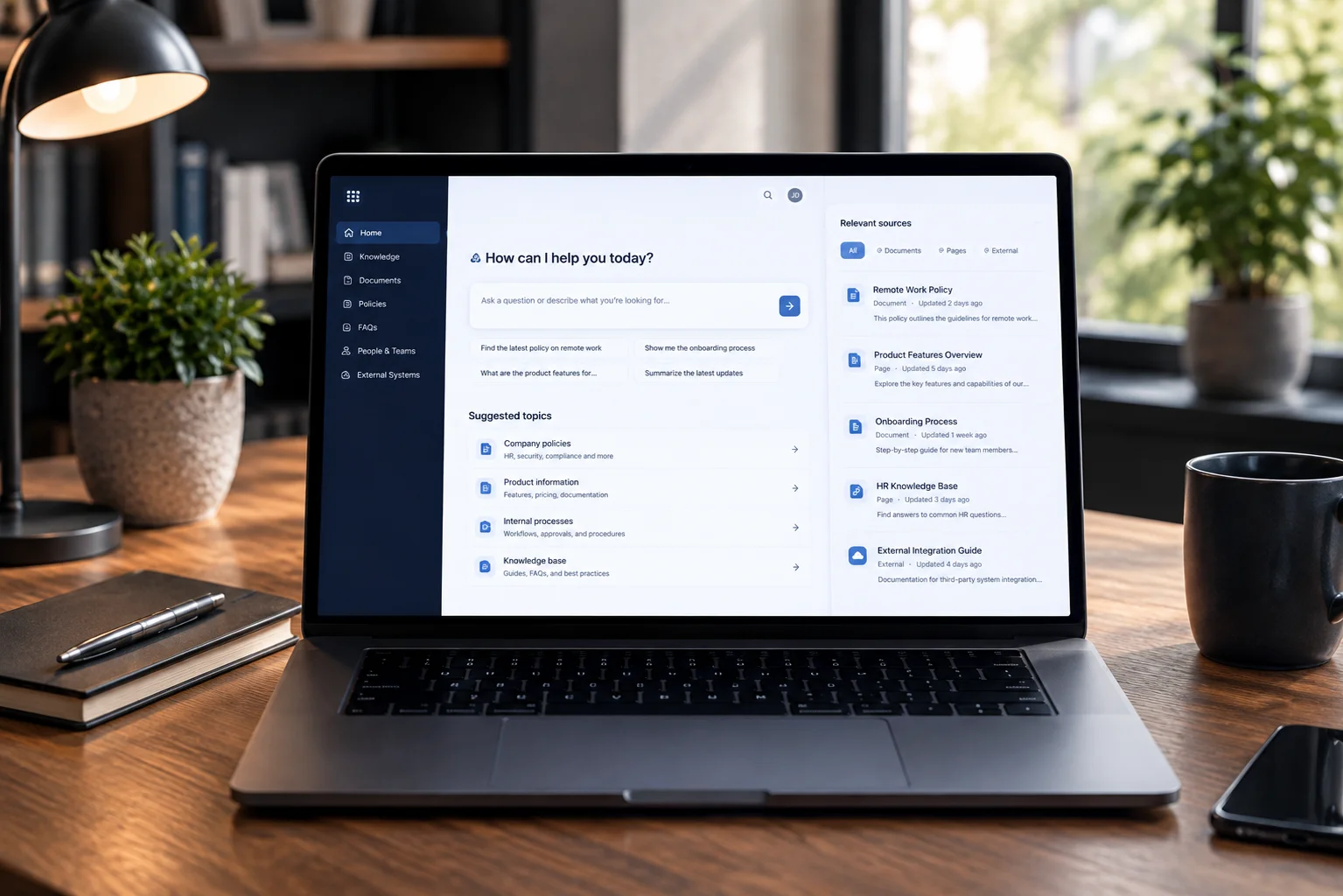
DreamDev built an AI-powered knowledge and automation layer that connects an existing WordPress ecosystem with enterprise data, intelligent retrieval, AI agents, and business workflows.
The goal was not to add another chatbot.
It was to make existing enterprise knowledge usable through AI.
-
The Challenge
The organization already had a large and valuable enterprise WordPress ecosystem. This required clear business requirements and technical planning before the AI architecture could be defined.
A user might know exactly what they need without knowing:
- which system contains the answer
- which document is relevant
- which page has the latest information
- which product or service applies to their situation
A conventional keyword search could return matching pages, but it could not reliably connect information across different sources or understand more complex requests.
At the same time, connecting a general-purpose LLM directly to the website was not enough.
Enterprise AI needs context.
It needs current information.
And most importantly, it needs boundaries.
The system had to work with trusted business data rather than relying on the model’s general knowledge.
-
We Didn't Build Another Chatbot
Instead of creating an isolated AI interface, DreamDev designed an AI integration layer around the existing digital ecosystem. This approach builds on the broader role of AI for WordPress, where artificial intelligence becomes part of the platform rather than a standalone feature.
01WordPress
The existing content and digital experience remain in place.
→02Enterprise Knowledge
Structured and unstructured business information becomes available
to the AI layer.→03AI Orchestration
Requests are interpreted, routed, and enriched with the right context.
→04AI Responses & Actions
The system can answer questions, retrieve information, summarize
data, or trigger connected workflows.This approach allowed AI capabilities to be introduced without
rebuilding the underlying WordPress platform. -
From Keyword Search to Contextual Answers
The difference becomes clear with a simple example. nstead of forcing users to search for the exact terminology used across enterprise content, the AI-powered search system understands the request, retrieves
relevant information, and builds the right context for the response.USER REQUEST“What are the requirements for this type of service and which related
options are available?”01
Intent Detection
The system identifies what the user is actually looking for.
→02
Retrieval
Relevant information is retrieved from connected enterprise sources.
→03
Context
The most useful information is assembled into the context provided
to the AI model.→04
Response
The user receives a contextual answer based on the organization’s
own information.THE RESULTThe experience moves from finding keywords
to finding meaning. -
The AI Doesn't Guess. It Retrieves.
At the core of the solution is Retrieval-Augmented Generation, or RAG.
Instead of asking an LLM to answer a question entirely from its pre-trained knowledge, the system first retrieves relevant information from trusted enterprise sources.
The workflow is straightforward:
Question → Retrieval → Context → Generation → Response
This architecture is particularly important for enterprise environments.
Business information changes constantly. Products are updated. Policies evolve. Documentation becomes outdated.
The AI therefore needs access to the organization’s current knowledge when a question is asked.
RAG provides the connection between the language model and the company’s actual information.
It also creates a more controlled architecture for applications where answers need to reflect specific business knowledge rather than generic information from the model.
-
Getting Things Done
The platform was designed to go beyond a single general-purpose AI assistant.
Different AI capabilities can be connected to specific data sources and workflows.
Knowledge Agent
Finds relevant information across connected enterprise sources and provides context-aware answers.
Search & Discovery Agent
Understands natural-language requests and retrieves relevant products, services, documents, or content.
Data Agent
Works with structured business information and connected APIs to retrieve and summarize relevant data.
Action Agent
Connects AI with approved business workflows, allowing selected actions to be triggered through existing systems.
This modular architecture makes it possible to introduce new AI capabilities without rebuilding the entire platform.
The result is an AI system that can evolve from answering questions to supporting real business processes.
-
Making Enterprise Data AI-Ready
The hardest part of enterprise AI is rarely the language model itself.
It is the data.
The solution was designed to work with different types of enterprise information, including:
- WordPress content
- Product and service information
- Documentation
- FAQs
- Policies
- Structured database records
- External API data
- Business documents
- Internal knowledge resources
Content is processed and prepared for retrieval so the AI layer can work with information in a format optimized for contextual search.
The architecture also supports ongoing synchronization.
When source information changes, the corresponding AI knowledge can be updated rather than relying on stale content.
This creates an important distinction between a static AI chatbot and an enterprise AI knowledge platform connected to live business information.
-
WordPress Remained Part of the Solution
Introducing AI did not require replacing the existing platform.
WordPress continued to handle the content and digital experience it was already responsible for.
DreamDev connected the AI capabilities to the existing WordPress architecture through custom development and APIs.
The result was a practical path to AI adoption:
Existing WordPress infrastructure
↓
AI integration layer
↓
New intelligent capabilities
This approach allows organizations to extend an existing WordPress ecosystem rather than taking on the cost and risk of a complete platform rebuild.
-
The Hard Part Wasn't the AI
Building a connection to an LLM is relatively straightforward.
Building a useful enterprise AI system is not.
The engineering challenge was making different parts of the ecosystem work together reliably.
Data
Information had to be collected from different sources and prepared for AI retrieval.
Context
The system needed to identify which information was actually relevant to each request.
Integration
AI capabilities had to work with WordPress and external business systems through APIs.
Synchronization
Changes in source data needed to propagate into the AI knowledge layer.
Security
Enterprise information cannot simply become available to anyone who asks an AI assistant a question.
Scalability
The architecture needed to support additional data sources, agents, workflows, and AI use cases over time.
This is where enterprise AI becomes an engineering problem rather than a prompt-engineering exercise.
-
Before and After
Before
Fragmented information
Content and business knowledge distributed across different sources.
Keyword-based discovery
Users had to search using terminology that matched the underlying content.
Manual research
Finding and consolidating information required navigating multiple systems.
Disconnected workflows
The website, knowledge sources, and business systems operated separately.
After
Natural-language discovery
Users can describe what they need instead of guessing the right keywords.
Contextual retrieval
Relevant information is retrieved from connected enterprise sources.
AI-assisted knowledge
The system can summarize and explain information using business-specific context.
Connected workflows
AI capabilities can interact with existing systems and support selected business processes through APIs.
-
By the Numbers
-
The Result
The project transformed AI from an isolated experiment into a reusable layer within the existing enterprise ecosystem.
The organization gained the ability to:
Search enterprise knowledge naturally
Users can ask questions in their own words instead of trying to guess the exact keywords used in a document or database.
Retrieve information from connected sources
AI can work with enterprise-specific information instead of relying only on general model knowledge.
Generate contextual responses
Retrieved information provides the context required to produce more relevant and useful answers.
Connect AI with business systems
The architecture creates a foundation for AI-powered workflows and actions through APIs.
Keep knowledge current
Synchronization mechanisms allow the AI layer to reflect changes in connected information sources.
Extend the platform over time
New agents, data sources, integrations, and workflows can be introduced without redesigning the entire solution.
Customer Testimonials
Here's what our customers say about DreamDev Solutions. Our clients appreciate our commitment to quality, efficiency, and innovation. With 40,000+ hours of hard work and a 93% returning customer rate, we have built long-term relationships based on trust and outstanding results.