We worked with Aleksandr and his team on the complex tech SEO project for the WordPress site and I was truly impressed. At Dreamdev, they are not just about getting things somehow done, they are all about quality, solution-orientation and deliverability. Their expertise is top-notch and attention to detail is what makes them as an agency extra special. Communication was flawless, which also ensured us reaching all the goals we set for the project. Aleksandr himself asks for the in-between feedback making sure his team grows. Can’t recommend more!
AI Customer Support Agent for WooCommerce
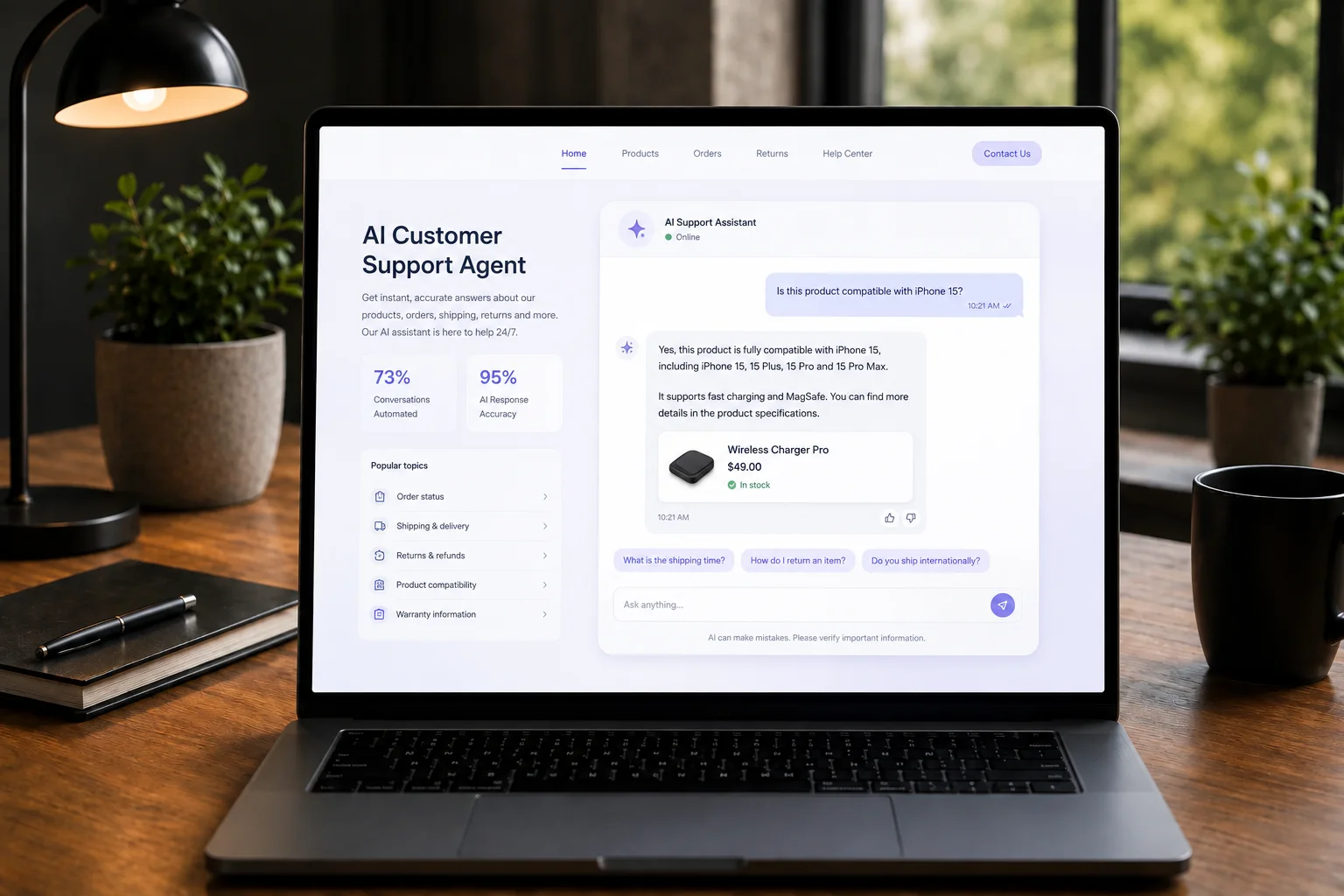
How We Built a Custom AI Agent That Automated 73% of Customer Support Conversations
-
Executive Summary
Customer support wasn’t the client’s biggest challenge.
Finding accurate answers was.
A growing European eCommerce company managed multiple WooCommerce stores with more than 40,000 products across several brands. Every day, their support team handled over 1,500 conversations covering product recommendations, shipping, returns, compatibility, warranties, and order-related questions. While most requests followed familiar patterns, answering them required searching across product catalogs, technical documentation, company policies, and internal knowledge bases.
The company had already experimented with AI chatbots. They handled simple FAQs but struggled with complex product questions, often generated inaccurate responses, and escalated too many conversations to human agents.
The business needed more than another chatbot. It needed an AI solution capable of understanding customer intent, retrieving verified business information, and responding with the same confidence as an experienced support specialist.
Our AI agent development team designed a custom AI platform that combines Retrieval-Augmented Generation (RAG), semantic search, business rules, and real-time WooCommerce data into a single intelligent workflow. Instead of relying on the language model alone, the system searches trusted company knowledge before generating every response, dramatically improving accuracy while minimizing hallucinations.
Within three months of launch, the platform automated 73% of first-line customer conversations, reduced first-response time by 92%, achieved 95% AI response accuracy, and decreased the support team’s workload by 58%, all while maintaining a seamless customer experience.
More importantly, the project established a reusable AI architecture that can support future custom AI agents for sales, internal operations, inventory management, and employee knowledge, without rebuilding the platform.
Looking to build scalable WordPress platforms with complex integrations? Explore our Custom WordPress Development Services.
-
The Challenge
As the business grew, customer support became increasingly difficult to scale.
The company operated several WordPress and WooCommerce websites, each with its own product catalog, shipping rules, and customer documentation. Every new product introduced additional questions, while seasonal sales created sharp spikes in support volume.
Most customer requests weren’t particularly complex. Customers wanted to know which product was compatible with their device, whether an item could be returned after opening, how quickly it would arrive, or which option best matched their needs.
The challenge wasn’t answering those questions. It was finding reliable information quickly.
Relevant data was spread across WooCommerce, PDF manuals, shipping policies, internal documentation, FAQs, and knowledge bases. Experienced support specialists knew where to look. New team members needed time to learn. Customers, of course, had no direct access to any of it.
Like many growing businesses, the client first explored commercial AI chatbot platforms. Deployment was straightforward, but the results weren’t.
The chatbot could answer basic FAQ-style questions, yet it struggled whenever a conversation required business context or product expertise. It couldn’t reliably search multiple knowledge sources, verify the latest product information, or distinguish between confident and uncertain answers. As a result, too many conversations were escalated to human agents, limiting the value of automation.
At that point, it became clear that the problem wasn’t a lack of conversational AI.
It was a lack of reliable business knowledge.
For organizations managing thousands of products, documentation, and constantly changing information, conversational ability alone isn’t enough. An effective AI solution must understand intent, retrieve trusted information, follow business rules, and know when a human should take over.
That realization fundamentally changed the direction of the project.
Instead of delivering another AI chatbot, we proposed building a custom AI agent designed around the client’s workflows and knowledge. Rather than relying on what a large language model “knows,” the agent would retrieve verified information in real time, reason over business data, and generate responses grounded in the company’s own documentation.
This shift transformed the project from a chatbot implementation into a scalable AI agent development initiative. The goal was no longer to automate conversations alone, but to build an intelligent support layer that could grow alongside the business and eventually power additional custom AI agents across other departments.
-
Why Traditional AI Chatbots Weren't Enough
Many businesses begin their AI journey by evaluating chatbot platforms, and for straightforward use cases, they can be an excellent starting point.
However, enterprise customer support presents a different challenge.
When customers ask detailed questions about product compatibility, shipping exceptions, warranties, or company policies, an AI system must do more than generate fluent text. It must retrieve the latest business information, validate it against company rules, and decide whether it has enough confidence to answer or whether the conversation should be escalated.
That’s the key difference between AI chatbot development and custom AI agent development.
A traditional chatbot is primarily designed to respond to messages. A custom AI agent is designed to solve problems. It can search multiple knowledge sources, work with external systems, follow business logic, and generate responses based on verified data rather than assumptions.
For this project, that distinction was critical.
The client didn’t need a better chatbot. They needed an AI agent that could become a reliable extension of their customer support team.
-
Our Solution: Building a Custom AI Agent
Instead of replacing the client’s existing support workflow, we designed an intelligent layer that works alongside it.
The objective wasn’t to build another chatbot. It was to create a custom AI agent capable of understanding customer intent, retrieving trusted business information, and generating responses grounded in the company’s own knowledge.
From the beginning, we approached the project as an AI agent development initiative rather than a conversational AI implementation.
That distinction shaped every architectural decision.
Instead of relying solely on a large language model, we built a modular AI platform where specialized components work together before a response reaches the customer. Each component has a single responsibility: understanding intent, retrieving relevant information, validating business rules, or generating the final answer.
This architecture delivers significantly higher accuracy than traditional AI chatbot solutions while remaining flexible enough to support future automation initiatives across the business.
-
Why Retrieval-Augmented Generation (RAG) Was Essential
One of the biggest misconceptions about AI is that a language model already knows everything a business needs.
It doesn’t.
Large language models are excellent at understanding language, but they don’t automatically know the latest product specifications, shipping policies, inventory changes, or internal documentation. Without access to reliable business data, even the most advanced models can produce confident but incorrect answers.
For customer support, that simply isn’t acceptable.
To solve this challenge, we implemented a Retrieval-Augmented Generation (RAG) architecture.
Whenever a customer asks a question, the AI agent doesn’t immediately generate a response. Instead, it first retrieves the most relevant information from multiple trusted sources, including WooCommerce product data, technical documentation, FAQs, shipping policies, return guidelines, and the company’s internal knowledge base.
Only after gathering verified context does the language model generate a response.
This retrieval-first approach dramatically reduces hallucinations while ensuring that every answer reflects the latest business information rather than outdated model knowledge.
Another advantage is maintainability.
As products, documentation, or policies evolve, the business simply updates its existing content. The AI automatically uses the latest information without requiring model retraining, making the platform far easier to scale over time.
Learn how we optimize WordPress websites for AI-powered search.
-
Solution Architecture
Customer
↓WordPress Chat Interface↓AI Gateway↓Intent Classification↓Knowledge Retrieval (RAG)↓Business Rules Validation↓OpenAI GPT-4.1↓Response Validation↓Customer Response↓Human Escalation (when needed)Rather than asking the language model to answer every question independently,
the platform guides each request through a controlled decision-making process.The AI first identifies what the customer is trying to accomplish.
It then retrieves relevant business information, validates that information
against company rules, and only then generates a response.Before an answer reaches the customer, an additional validation layer
evaluates confidence scores and checks whether the retrieved context is
sufficient. If the platform cannot answer reliably, the conversation is
automatically transferred to a human support specialist together with all
relevant context.This hybrid approach combines the speed of AI with the reliability of human
expertise, giving customers accurate answers without sacrificing trust. -
Key AI Capabilities
Rather than acting as a single-purpose chatbot, the platform behaves as a collection of specialized AI capabilities working together.
AI Customer Support
Answers product, shipping, warranty, and policy questions using verified company knowledge instead of generic internet information.
Intelligent Product Recommendations
Understands customer intent and recommends products based on compatibility, requirements, and business rules instead of simple keyword matching.
Knowledge Retrieval
Searches thousands of pages of documentation, product data, technical manuals, FAQs, and internal knowledge within seconds using semantic search.
Order Assistance
Guides customers through shipping options, delivery estimates, return policies, and order-related questions using company-specific workflows.
Human Escalation
Recognizes when confidence is too low or when human judgment is required, automatically transferring the conversation together with all retrieved context.
This modular design makes it easy to introduce additional custom AI agents for sales, inventory management, employee support, or internal operations without redesigning the entire platform.
-
Technology Stack
Selecting the right technologies wasn’t about following AI trends.
It was about building a platform that could remain reliable, scalable,
and easy to extend as the client’s business evolves.Layer Technology Frontend WordPress, React AI Interface Custom WordPress Plugin Backend Python, FastAPI AI Orchestration LangGraph LLM OpenAI GPT-4.1 Vector Database Pinecone Semantic Search Hybrid Search Cache Redis Infrastructure Docker, AWS Monitoring LangSmith, OpenTelemetry Every component was selected for a specific purpose.
WordPress and WooCommerce remained the foundation of the customer experience,
while a custom plugin securely connected the website to the AI platform.
LangGraph orchestrated multi-step AI workflows, Pinecone enabled fast semantic
retrieval across large knowledge bases, and FastAPI provided a high-performance
backend for real-time interactions.Although OpenAI GPT-4.1 was selected for this implementation, the architecture
intentionally avoids vendor lock-in. The same platform can support alternative
language models such as Anthropic Claude, Google Gemini, or self-hosted
open-source models as business requirements evolve. -
Development Process
Building a production-ready AI solution involves much more than connecting a language model to a website.
Our development process focused on creating an AI platform that could deliver reliable responses today while remaining easy to expand as the business evolves.
Discovery & AI Strategy
We analyzed customer support workflows, reviewed historical conversations, identified repetitive requests, and mapped how business knowledge was distributed across WooCommerce, documentation, and internal systems.
This discovery phase helped us define business rules, escalation scenarios, and the AI workflows that would guide every customer interaction.
Knowledge Engineering
Next, we transformed thousands of documents into a structured knowledge base.
Product catalogs, FAQs, shipping policies, technical manuals, and internal documentation were cleaned, categorized, enriched with metadata, and indexed for semantic search.
Rather than storing everything in a single repository, we organized information into specialized knowledge collections, allowing the AI agent to retrieve only the most relevant content for each request.
AI Agent Development
Using LangGraph, we developed modular AI workflows that combine intent classification, Retrieval-Augmented Generation (RAG), business validation, and response generation into a single orchestration pipeline.
Instead of relying on prompt engineering alone, every response is built on verified company information and validated before reaching the customer.
WordPress Integration
To preserve the existing customer experience, we developed a lightweight custom WordPress plugin that securely connects the WooCommerce website with the AI platform.
The integration feels like a native part of the website while keeping API credentials and business logic safely on the server side.
Continuous Improvement
Unlike traditional software, AI systems improve through evaluation.
After launch, we continuously monitored retrieval quality, response accuracy, latency, and escalation behavior, refining the platform based on real customer conversations instead of assumptions.
-
Results
Within three months of deployment, the platform became an extension of the client’s
customer support team rather than a replacement for it.Instead of automating conversations for the sake of automation, the AI focused on
repetitive, information-driven requests, allowing specialists to dedicate their
time to complex customer cases.Business Impact
KPI Result First-response time 92% faster Customer conversations automated 73% Support workload 58% lower AI response accuracy 95% Customer satisfaction +21% Average response time 2.3 seconds During peak sales periods, the AI successfully handled thousands of conversations
without requiring the client to expand their support team.Looking for more WordPress transformation projects? Browse our latest case studies.
-
Why This Architecture Scales
One of the client’s key objectives wasn’t simply solving today’s support challenges.
They wanted an AI platform capable of growing with the business.
Because retrieval, orchestration, validation, and business logic are separated into independent services, the same architecture can support additional custom AI agents without redesigning the platform.
The client is already extending this foundation with AI-powered workflows for inventory analysis, supplier communication, sales assistance, and internal knowledge management.
This is one of the biggest advantages of custom AI agent development over standalone chatbot platforms. Instead of deploying isolated tools for individual tasks, businesses gain a scalable AI ecosystem built around their own processes.
Customer Testimonials
Here's what our customers say about DreamDev Solutions. Our clients appreciate our commitment to quality, efficiency, and innovation. With 40,000+ hours of hard work and a 93% returning customer rate, we have built long-term relationships based on trust and outstanding results.