
Enterprise WordPress Trends for 2027: What Technology Leaders Should Prepare For
WordPress Development

Enterprise WordPress has evolved far beyond traditional website management. In 2026, organizations expect their digital platforms to deliver exceptional performance, seamless integrations, AI-assisted workflows, and enterprise-grade security while remaining flexible enough to support future business growth.
If you’re looking for a complete overview of enterprise architecture, scalability, governance, and implementation, start with our Enterprise WordPress Development Guide. This article focuses on the emerging trends that are shaping the next generation of enterprise WordPress platforms.
1. AI Is Becoming Part of Everyday Development
AI is no longer an experimental tool. Development teams increasingly rely on AI to accelerate coding, generate documentation, review pull requests, identify bugs, and automate repetitive tasks.
Rather than replacing developers, AI enables experienced engineers to deliver projects faster while maintaining code quality and consistency.
2. Composable Architecture Continues to Grow
Instead of relying on a single monolithic platform, enterprise organizations are building ecosystems composed of specialized services.
WordPress increasingly acts as the content hub while integrating with:
- CRM platforms
- ERP systems
- Marketing automation
- Search platforms
- Customer portals
- Analytics tools
This modular approach provides greater flexibility and simplifies future expansion.
3. Headless WordPress Is Becoming More Strategic
Headless WordPress continues to gain popularity, but organizations are adopting it more selectively.
Companies now evaluate whether a traditional, hybrid, or fully headless architecture delivers the greatest business value rather than choosing headless simply because it’s a trend.
4. Performance Is a Business Metric
Core Web Vitals remain important, but enterprise organizations now measure performance by its business impact.
Faster websites improve:
- conversion rates
- SEO visibility
- user engagement
- accessibility
- operational efficiency
Performance optimization has become a continuous process rather than a one-time project.
5. Security Starts Earlier in the Development Process
Security is increasingly integrated into every stage of development.
Modern enterprise teams automate:
- dependency monitoring
- vulnerability scanning
- code quality analysis
- deployment validation
- infrastructure monitoring
This proactive approach reduces operational risks and simplifies compliance.
6. Governance Matters More Than Ever
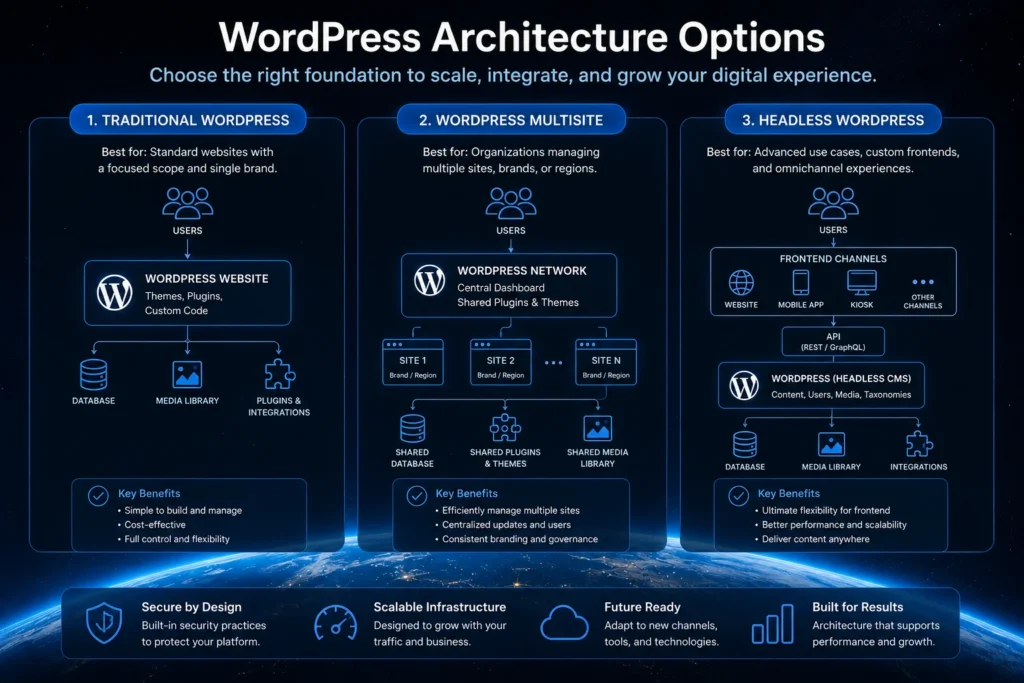
Large organizations often manage multiple brands, teams, and content editors.
Successful enterprise platforms now prioritize:
- clear publishing workflows
- role-based permissions
- approval processes
- content governance
- centralized management
Strong governance enables teams to scale without sacrificing consistency.
7. API-First Integrations Continue to Replace Custom Imports
Modern WordPress platforms increasingly rely on APIs to synchronize content and business data in real time.
Common integrations include:
- HubSpot
- Salesforce
- Microsoft Dynamics
- ERP platforms
- Property management systems
- E-commerce platforms
Reliable API architecture improves both operational efficiency and user experience.
8. GEO Optimization Is Becoming Part of Enterprise SEO
As AI-powered search engines become more widely used, enterprise websites need to optimize content not only for traditional search engines but also for AI assistants.
Structured data, semantic HTML, clear information architecture, and authoritative content improve visibility across both search engines and AI-generated answers.
9. Accessibility Is Now a Standard Requirement
Accessibility is no longer considered an optional enhancement.
Enterprise organizations increasingly design and develop websites that comply with accessibility standards from the beginning, reducing future costs while improving usability for all visitors.
10. Long-Term Maintainability Wins
The most successful enterprise platforms are designed for years of continuous evolution.
Organizations increasingly prioritize:
- modular architecture
- reusable components
- automated testing
- comprehensive documentation
- scalable deployment processes
Investing in maintainability helps reduce technical debt and supports long-term business growth.
How DreamDev Solutions Builds Enterprise WordPress Platforms
At DreamDev Solutions, we build enterprise WordPress platforms with strategy first thinking. We start by understanding the business model, editorial workflow, technical needs, and growth goals. That process helps us choose the right solution instead of forcing every project into the same pattern.
Our process usually begins with business analysis for WordPress, because the success of an enterprise platform depends on more than visuals. We need to understand how the team publishes, what the site must support, what systems need to connect, and how the business expects to grow.
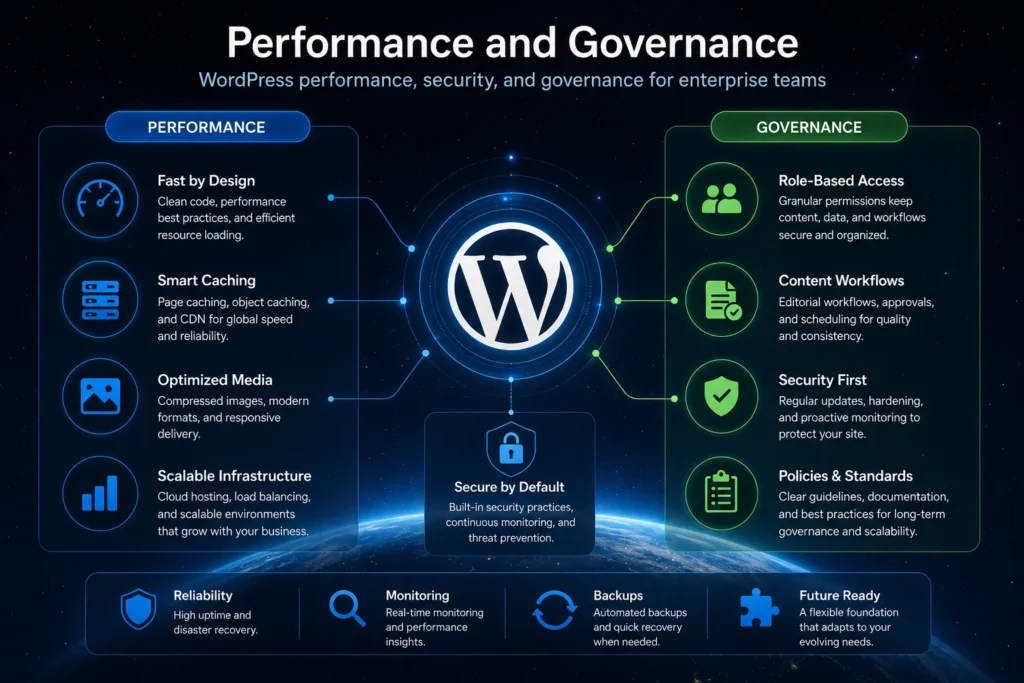
From there, we shape the architecture. That may mean a custom theme, a multisite system, a headless frontend, or a hybrid approach. We also plan for performance from the start so the site is built to stay fast and stable, not patched later.
For larger projects, our custom WordPress development work can include code refactoring, platform improvements, structured content systems, and a more maintainable technical foundation. When design matters, our WordPress UX and UI design service helps make the interface clear, modern, and conversion focused.
And when a company needs ongoing technical support, our WordPress agency support service can extend an internal team with experienced specialists who understand the realities of enterprise work.
This is where DreamDev stands out. We do not treat enterprise WordPress as a template. We treat it as a system that should support the business for years, not just for launch day.
Frequently Asked Questions
Is WordPress suitable for enterprise websites?
Yes. WordPress can be an excellent enterprise platform when it is built with the right architecture, governance, and performance strategy.
What is the difference between regular WordPress and enterprise WordPress?
Regular WordPress usually supports smaller publishing needs. Enterprise WordPress supports larger teams, more complex content models, stronger security requirements, and higher performance expectations.
Is headless WordPress better for enterprise projects?
Not always. Headless WordPress is best when the project needs a highly custom frontend or omnichannel content delivery. Traditional WordPress is often better when simplicity and editorial usability matter more.
How do I choose the right theme for an enterprise WordPress site?
Choose a theme strategy that is lightweight, accessible, flexible, and maintainable. For enterprise projects, a custom built theme is often the strongest option.
Why should a business work with DreamDev Solutions?
DreamDev Solutions combines strategy, development, design, performance optimization, and WordPress expertise to build enterprise platforms that support real growth.
Final Thoughts
Enterprise development is about building a platform that can support growth without becoming fragile. The right architecture, the right theme strategy, strong performance, and clear governance all matter.
If your organization needs a WordPress platform that is designed for scale, not just launch day, DreamDev Solutions can help. The best enterprise websites are not only visually strong. They are fast, secure, maintainable, and ready for the next stage of growth.
Ready to build a better enterprise WordPress platform? Contact DreamDev Solutions and start planning a site built for performance, scale, and long term success.
-
 WordPress Development
 Taking Over an Existing WordPress Website: A Technical Guide for Agencies
Taking over an existing WordPress website? This technical guide helps agencies assess infrastructure, code, security, integrations, SEO, performance, and technical risks before accepting responsibi...
11.06.2026 -
WordPress Development
How to Handle WordPress Development Overflow Without Hiring
Learn how to handle WordPress development overflow, add flexible capacity, and take on more projects without rushing into a full-time hire.
11.06.2026 -
Performance & SEO
AI-Ready WordPress Architecture: How to Prepare Your Website for AI Search
Search is changing. People are no longer relying only on short keyword queries to find information. They increasingly ask complex questions, compare solutions, and use AI-powered search experiences...
11.06.2026