
WordPress Trends for 2026: Market Share, Headless Adoption, and What Businesses Need to Know
Business Analysis Insights News WordPress Development


WordPress remains the most widely used content management system on the web. W3Techs reports that WordPress powers 42.2% of all websites and 59.6% of websites with a known CMS. That scale still makes WordPress one of the most important platforms for businesses, agencies, and developers in 2026. For companies planning a modern WordPress build, DreamDev Solutions can help turn that foundation into a scalable, high-performing site.
At the same time, the market around WordPress is changing. More teams are combining WordPress with React, Next.js, Vue, Nuxt, Docker, and managed hosting instead of relying on a traditional all-in-one WordPress build. The result is a more modular ecosystem where WordPress often works as the content layer inside a broader digital stack.
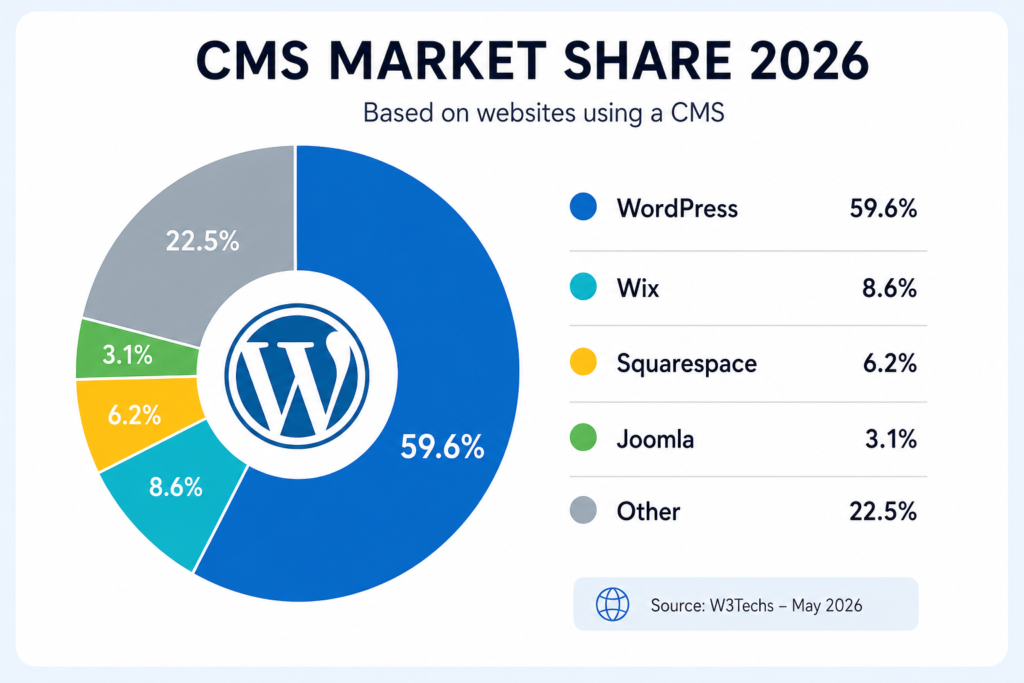
WordPress market share 2026
Why WordPress Still Leads
The main reason WordPress continues to lead is simple. It is flexible, familiar, and supported by a massive ecosystem of plugins, themes, hosting providers, and developers. That makes it a practical choice for blogs, corporate sites, media projects, landing pages, and online stores.
The ecosystem also remains active at the subtechnology level. W3Techs shows Elementor at 31.1 % of WordPress sites and WooCommerce at 20% of WordPress sites in its April 2026 trend data. That means a very large share of WordPress builds still rely on visual editing and commerce tooling rather than custom code alone.
This matters for businesses because WordPress is no longer just a blogging platform. It is a content engine, a marketing layer, and often a commerce foundation as well.
What Is Changing in the Market
The biggest structural change is the move toward headless and hybrid architectures. In this model, WordPress stays in the background as the CMS, while the public facing front end is built with React, Next.js, Vue, or Nuxt. DreamDev custom WordPress development can help businesses evaluate whether this setup is the right fit for their content, performance, and scalability goals.
This shift is driven by performance, flexibility, and better control over the user experience. It is especially attractive for brands that need stronger Core Web Vitals, richer interfaces, or more advanced front-end logic. The broader developer ecosystem reflects this direction too. In Stack Overflow’s 2023 survey, WordPress still appears among commonly used web technologies, while React, Node.js, Next.js, and Vue remain highly relevant in the same development stack.
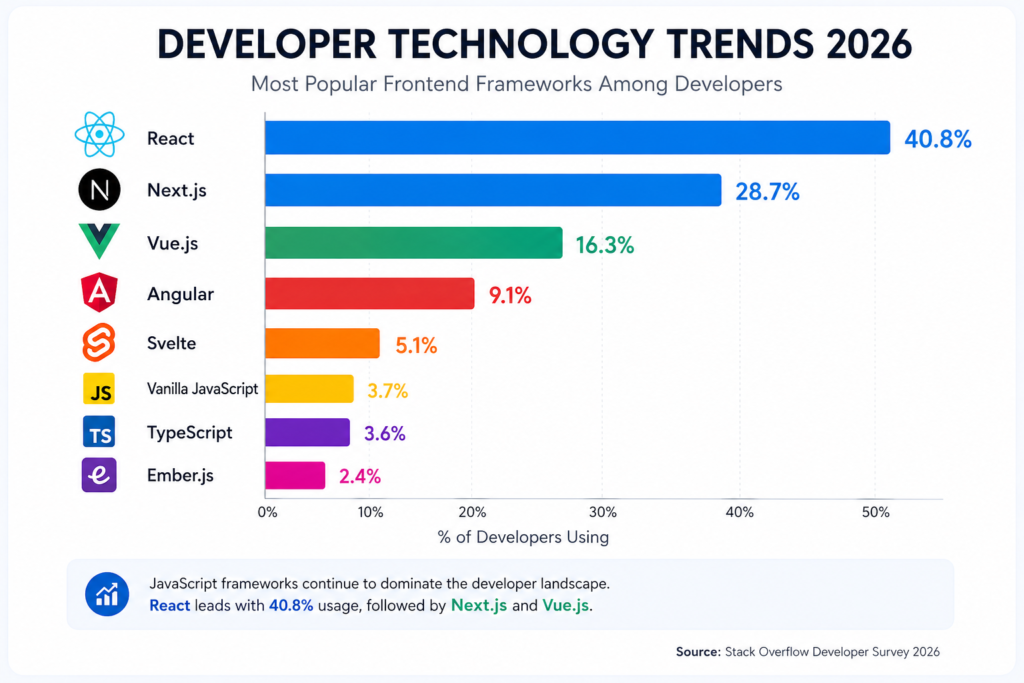
WordPress developer technology trends 2026
The New WordPress Skill Set
A WordPress developer in 2026 often needs more than PHP. The market increasingly rewards developers who understand JavaScript frameworks, APIs, deployment workflows, and performance optimization.
That trend also appears on freelance platforms. Upwork’s 2023 report listed CMS Development among the top ten most in demand tech skills, alongside full stack development, front-end development, back end development, e-commerce website development, UX and UI design, and scripting and automation.
This is an important signal. It shows that the market is not asking for a narrow WordPress specialist only. It is asking for people who can connect content, commerce, performance, and frontend experience into one project.
Key Market Signals
| Signal | What the data suggests | Why it matters |
| WordPress market share | 42.2% of all websites, 59.6%t of sites with known CMS | WordPress still has a huge installed base and strong demand |
| Elementor and WooCommerce usage | Elementor at 31.1%, WooCommerce at 20% of WordPress sites | Visual building and commerce are core parts of the ecosystem |
| Freelance demand | CMS Development is in Upwork’s top ten tech skills | WordPress remains commercially valuable for freelancers and agencies |
| Developer stack shift | React, Next.js, Vue, Node.js stay central in developer workflows | WordPress is increasingly part of a hybrid stack rather than a standalone system |
WordPress, WooCommerce, and Shopify
Commerce is one of the clearest examples of how the WordPress market is evolving. WooCommerce remains the natural choice for teams that want content and store management inside one system. It is a strong fit for small and mid-sized stores, especially when blogging, SEO, and product marketing need to live together.
At the same time, many agencies now combine WordPress with Shopify. This hybrid model is attractive when a business wants to keep content in WordPress but delegate checkout, payments, and commerce operations to Shopify. It is not the simplest setup, but it can be the best one for content heavy brands and businesses with more complex commerce needs.
| Option | Strengths | Tradeoffs | Best fit |
| WordPress plus WooCommerce | Unified content and store management, large plugin ecosystem, easier editorial workflow | Can become heavy with large catalogs, needs optimization | Small and mid-sized e-commerce sites |
| WordPress+Shopify | Strong commerce workflows, stable checkout, clean separation of content and sales | Integration work, added platform cost, duplicate maintenance | Content heavy brands and hybrid commerce sites |
Performance and Security Are No Longer Optional
As WordPress sites become more complex, performance and security matter more than ever. Google’s SEO Starter Guide recommends useful and unique content, descriptive URLs, sitemaps, relevant links, and clear control over duplicate content through canonicalization and robots directives. It also stresses that search visibility improves when content is easy to discover and understand.
That lines up with good WordPress architecture. A strong site should have a logical URL structure, useful internal linking, optimized images, and efficient asset loading. Technical SEO on WordPress is not just about metadata. It is also about crawlability, speed, and user experience.
Security deserves the same attention. WordPress sites should be updated regularly, managed carefully at the plugin and theme level, and protected with hosting level security, CDN features, and WAF controls. For many businesses, managed hosting is not a luxury. It is a risk reduction strategy.
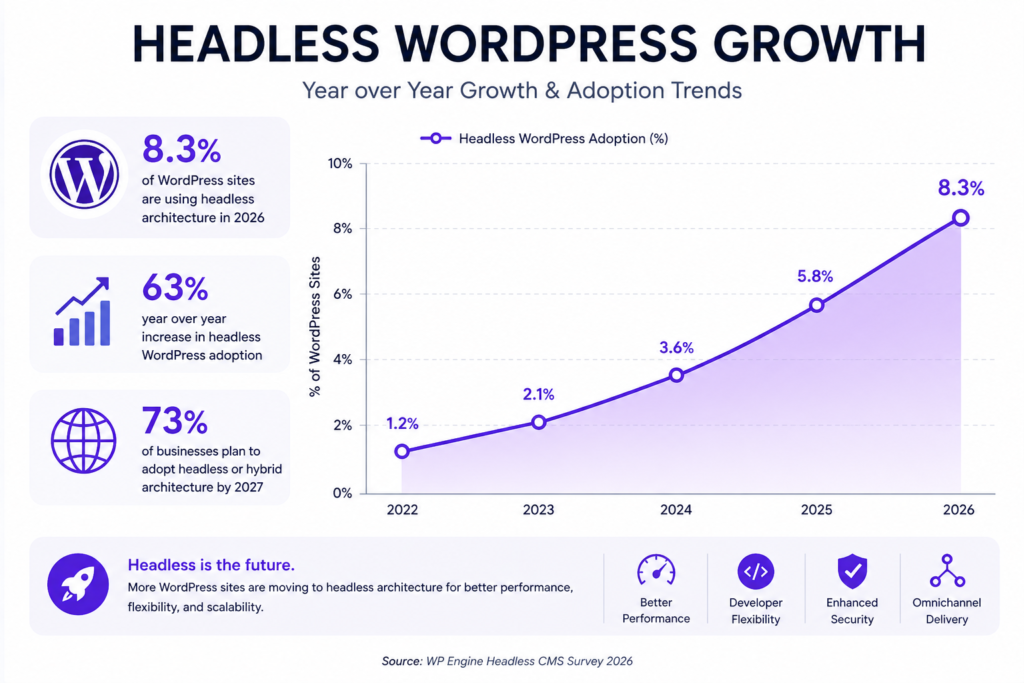
WordPress Headless Growth
What the Technology Stack Looks Like Now
The WordPress market in 2026 is best understood as a family of related stacks rather than a single stack.
| Stack | Strengths | Tradeoffs | Typical use case |
| Classic WordPress | Easy to launch, large community, many plugins and themes | Can be slower, security and maintenance need attention | Blogs, corporate sites, portals |
| WordPress plus Elementor or Divi | Fast visual building, lower initial effort | Heavier pages, more plugin dependence | Marketing sites, MVPs, small business sites |
| Headless WordPress plus React or Next.js | Fast front-end, flexible UI, strong SEO potential | More complex development and deployment | Large sites, custom portals, modern web apps |
| Headless WordPress plus Vue or Nuxt | Similar benefits with Vue based front-ends | Smaller ecosystem than React in some cases | SPA style sites and interactive experiences |
| WordPress plus WooCommerce | Content and commerce in one ecosystem | Can require tuning for larger catalogs | Small and mid-sized e-commerce |
| WordPress plus Shopify | Strong commerce stack with WordPress content | More integration and platform overhead | Hybrid brands and content led commerce |
Global Market Patterns
WordPress is strong across many countries, but the way it is used differs by market. In some regions the platform is still mostly traditional. In others, agencies and businesses are moving toward headless, e-commerce integration, and managed infrastructure.
The broad pattern is clear. Mature markets tend to demand more performance, security, and integration work. That makes headless WordPress, WooCommerce, Shopify integration, and modern frontend stacks especially relevant for larger businesses and agencies.
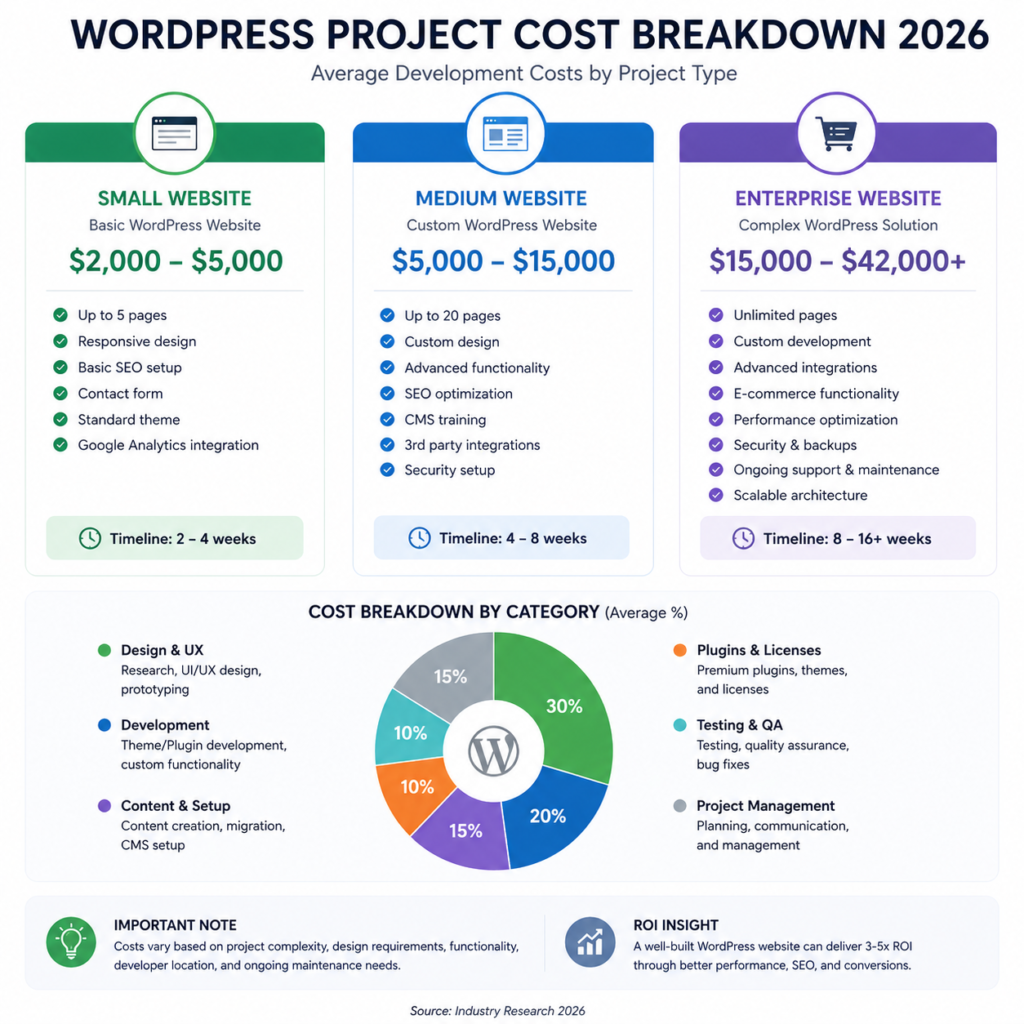
WordPress Project Cost
What This Means for Businesses
For small businesses, WordPress is still one of the fastest and most cost effective ways to launch a credible website. A clean theme, a reliable host, and a focused content strategy are often enough.
For growing companies, the better option is usually a more structured WordPress build. That may include custom blocks, stronger SEO architecture, performance work, CRM integration, and e-commerce support. If the site has a lot of traffic or needs a richer interface, headless WordPress becomes more attractive.
For enterprise teams, WordPress is increasingly best used as one layer inside a broader digital architecture. In that model, WordPress handles editorial workflow and structured content, while the front-end, caching, deployment, and security stack are handled separately.
FAQ
What is the biggest WordPress trend in 2026?
The biggest trend is the move toward headless and hybrid architectures, where WordPress is used as the CMS while the front-end is built with React, Next.js, Vue, or Nuxt.
Is WordPress still the dominant CMS?
Yes. W3Techs reports that WordPress powers 42.2% of all websites and 59.6% of sites with a known CMS.
Is WooCommerce still relevant?
Yes. WooCommerce remains one of the most important commerce layers in the WordPress ecosystem, especially for smaller and mid-sized stores. W3Techs shows it used on 20% of WordPress sites in its April 2026 trend data.
Should WordPress developers learn React or Next.js?
Yes. The market increasingly expects WordPress developers to work with modern frontend stacks, API based architecture, and deployment tools. Stack Overflow’s 2023 survey shows React, Node.js, Next.js, Vue, and WordPress all playing meaningful roles in developer workflows.
Final Takeaway
WordPress is not fading. It is evolving.
The platform still dominates the CMS market, but the surrounding stack is becoming more modern, more performance-focused, and more specialized. The most important opportunities now sit at the intersection of WordPress, headless architecture, e-commerce, and frontend engineering.
For businesses, that means WordPress is still a strong choice, but only when it is matched to the right architecture. Companies that want to build scalable, high-performing WordPress solutions can explore expert support at DreamDev Solutions.
For developers and agencies, it means the market rewards broader technical skill, not just basic theme work.
-
 WordPress Development
 Outsourced WordPress Development: Why More Companies Are Choosing Specialized Partners Over In-House Teams
Explore the benefits of outsourced WordPress development for complex websites. Compare in-house teams, agencies, and specialized partners while discovering why more businesses choose enterprise Wor...
01.05.2026 -
WordPress Development
Enterprise WordPress Development in 2026: How to Build Scalable, Secure, High Performance Platforms
Enterprise WordPress development is about more than themes and plugins. In this guide, DreamDev Solutions explains how to build scalable, secure, high performance WordPress platforms with the right...
01.05.2026 -
WordPress Development
WPGraphQL vs REST API for Headless WordPress in 2026
WPGraphQL vs REST API: which is the better choice for headless WordPress in 2026? Learn how both approaches compare across data fetching, frontend development, performance, SEO, scalability, and co...
01.05.2026