
AI for WordPress: A Practical Guide to Smarter Websites, Automation, and AI Agents
Business Analysis Insights WordPress Development

Artificial intelligence is changing how businesses build, manage, and grow digital products. For WordPress websites, the shift goes far beyond AI-generated content or chatbots. Today’s AI solutions can automate customer support, improve website search, streamline editorial workflows, personalize shopping experiences, and help teams make faster business decisions.
The real opportunity isn’t replacing WordPress with AI. It’s extending WordPress with intelligent capabilities that solve real business problems.
Whether you manage a WooCommerce store, a content platform, a membership website, or an enterprise WordPress solution, AI can automate repetitive work, improve customer experience, and help your team focus on higher-value tasks. The challenge is choosing the right approach. While AI plugins work well for simple use cases, growing businesses often need custom AI solutions that integrate with existing systems, proprietary data, and business workflows.
In this guide, we’ll explore what AI for WordPress really means, where it delivers measurable business value, and how businesses can move from simple AI tools to scalable AI-powered solutions.
Learn more about our Custom WordPress Development services.
What Is AI for WordPress?
AI for WordPress refers to using artificial intelligence to enhance how WordPress websites operate, automate processes, and deliver better user experiences.
For some businesses, that means using AI to generate content or improve SEO. For others, it involves intelligent search, personalized product recommendations, customer support, workflow automation, or AI agents that interact with business systems and company knowledge.
The biggest misconception is that AI is simply another WordPress plugin.
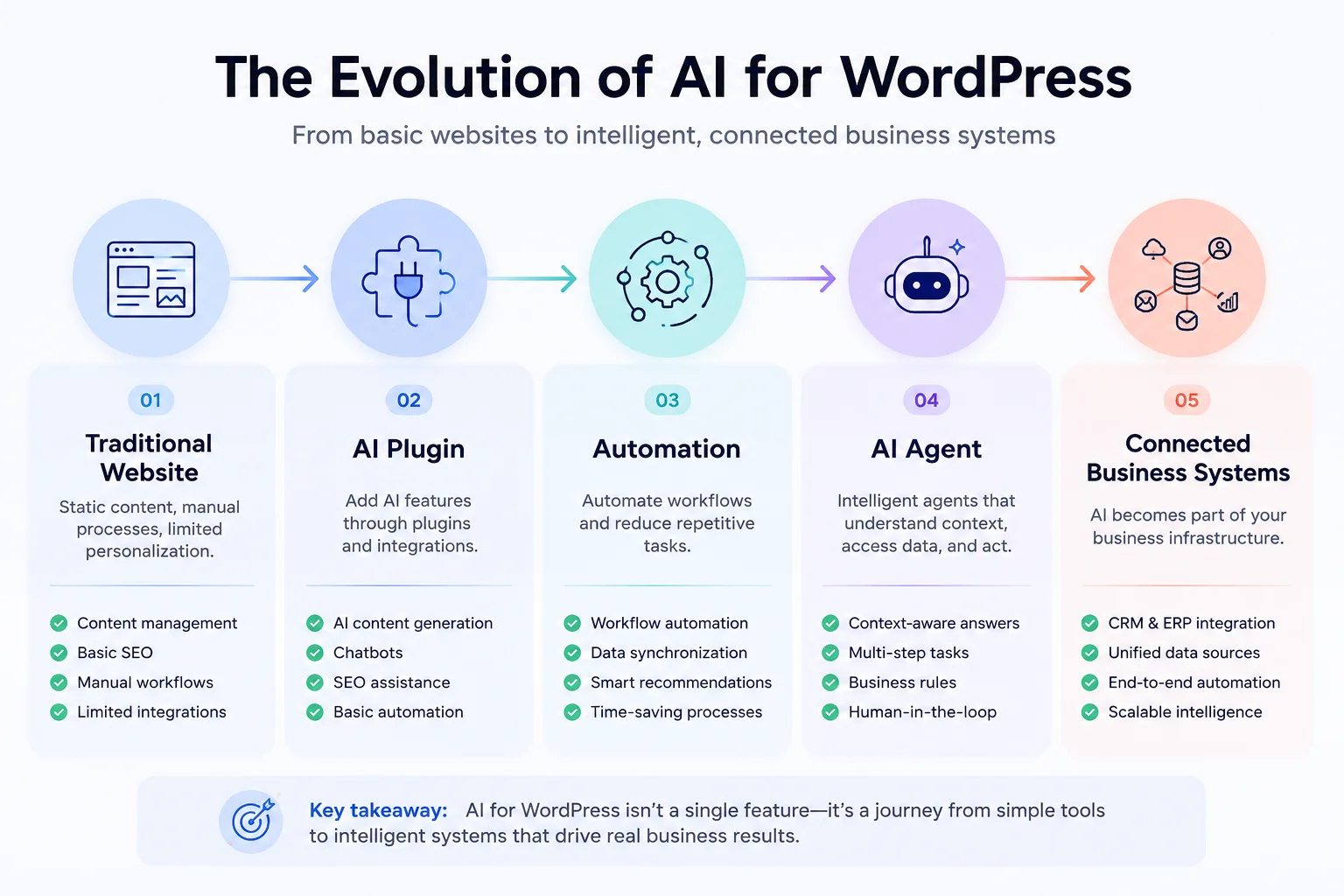
In reality, AI can operate on multiple levels:
- Content assistance for drafting, editing, and translating content.
- Customer experience through conversational AI, product discovery, and recommendations.
- Business automation that connects WordPress with CRMs, ERPs, support platforms, or internal knowledge bases.
- AI agents capable of retrieving information, following business rules, and completing multi-step tasks.
As business requirements become more sophisticated, AI evolves from a helpful feature into part of the company’s digital infrastructure.
WordPress remains the platform that delivers content and user experiences, while AI becomes the intelligence layer that supports customers, employees, and business operations.
Key takeaway: AI doesn’t replace WordPress — it extends its capabilities by making websites more intelligent, automated, and data-driven.
Why Businesses Are Investing in AI for WordPress
The growing interest in AI isn’t driven by technology alone. It’s driven by business needs.
Modern websites are expected to do much more than publish content. They answer customer questions, recommend products, collect leads, process orders, integrate with multiple systems, and support increasingly personalized user experiences.
Managing these processes manually becomes difficult as businesses grow.
Artificial intelligence helps organizations automate repetitive work while giving customers faster, more relevant, and more consistent interactions.
Some of the most valuable applications include:
- Providing instant customer support without increasing support headcount.
- Delivering personalized product recommendations based on user intent.
- Improving website search with semantic understanding instead of simple keyword matching.
- Assisting editorial teams with research, drafting, translations, and content optimization.
- Automating repetitive workflows between WordPress and third-party business systems.
The value of AI is no longer measured by how well it can generate text. It’s measured by how effectively it helps businesses reduce manual work, improve decision-making, and create better digital experiences.
Where AI Creates the Greatest Business Value
Not every AI implementation produces meaningful results.
The most successful projects focus on solving clearly defined business challenges rather than adopting AI for its own sake.
In our experience, businesses typically see the highest return on investment in four areas.
Customer Support
AI can answer routine questions, retrieve information from company knowledge bases, and guide customers through common processes such as shipping, returns, or product selection. By handling repetitive conversations, support teams can focus on complex requests where human expertise adds the most value.
Content Operations
Editorial teams increasingly use AI to accelerate content production, summarize research, improve readability, generate metadata, and assist with multilingual publishing. AI speeds up workflows, but human review remains essential for maintaining accuracy and brand voice.
Intelligent Search and Product Discovery
Traditional website search relies on keywords. AI-powered semantic search understands user intent, helping visitors find products, documentation, or content even when they don’t use the exact terms stored in the database. This creates a smoother experience and often improves engagement and conversions.
Business Process Automation
One of the biggest opportunities lies beyond the website itself. AI can connect WordPress with CRM platforms, customer support tools, internal documentation, marketing systems, custom applications, and HubSpot Integration reducing repetitive work and improving data consistency across the business.
Key takeaway: The greatest value of AI comes from improving business processes, not simply adding new website features.
AI Plugins vs. Custom AI Development
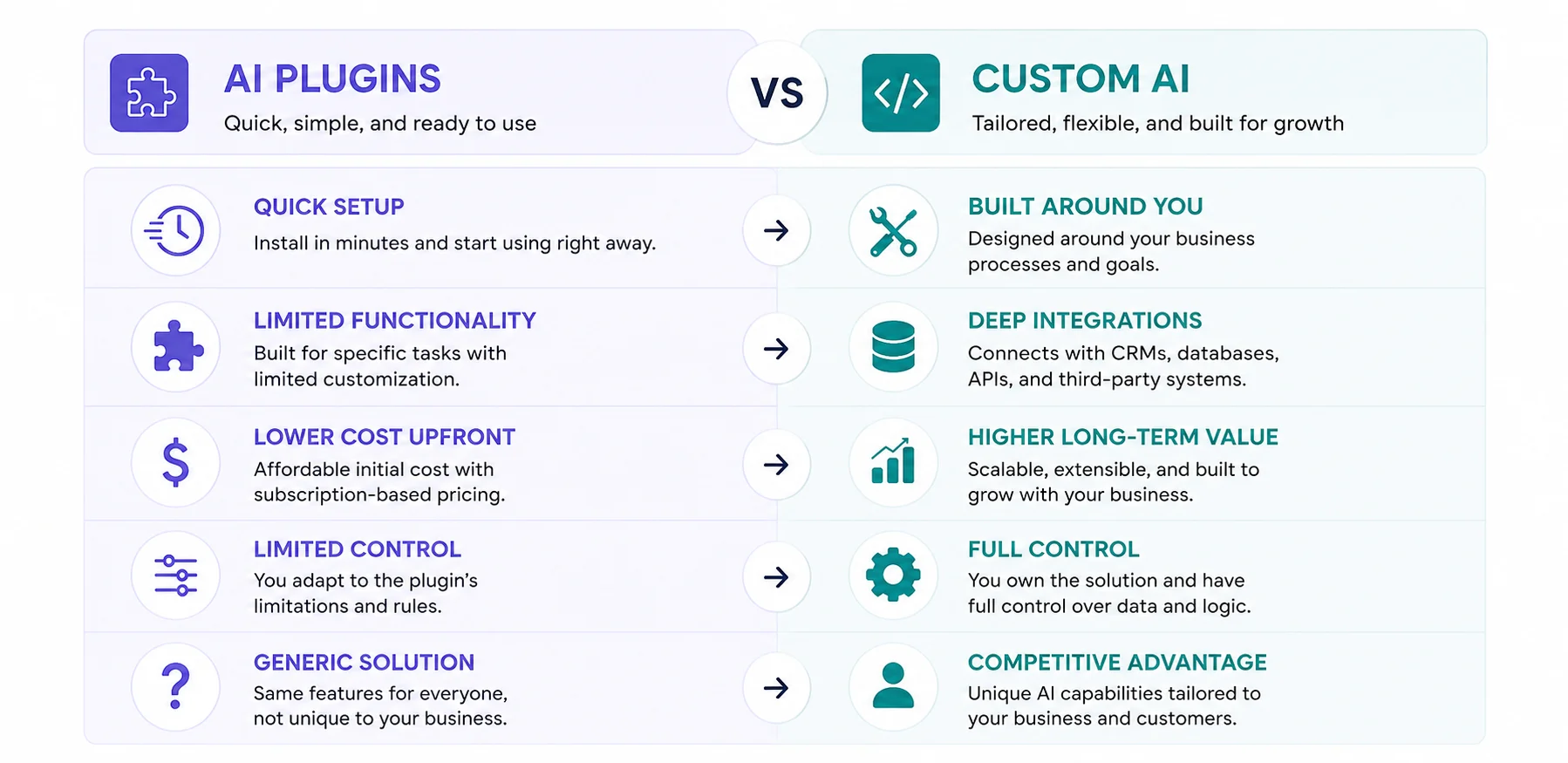
One of the first decisions businesses face is whether an off-the-shelf AI plugin is enough or whether they need a custom AI solution.
The answer depends on what you expect AI to accomplish.
If your goal is to generate blog posts, improve writing, create meta descriptions, or add a simple chatbot, an AI-powered WordPress plugin is often the fastest and most cost-effective option. Modern plugins can significantly improve productivity without requiring custom development.
However, business requirements tend to grow.
Companies soon want AI to answer questions using internal documentation, recommend products based on real customer data, automate workflows between WordPress and external systems, or support customer service with access to company knowledge. These capabilities require much more than a plugin.
Custom AI development allows businesses to build solutions around their own processes instead of adapting processes to fit a generic product.
Instead of relying on predefined features, custom AI can securely connect with CRMs, ERPs, WooCommerce, proprietary databases, APIs, and internal knowledge bases, creating intelligent workflows tailored to the business.
For organizations managing large amounts of data or complex operations, this flexibility often delivers greater long-term value than standalone AI tools.
| AI Plugins | Custom AI Development |
| Quick to install | Designed around your business |
| Best for simple tasks | Handles complex workflows |
| Limited integrations | Connects with business systems |
| Shared functionality | Built for specific business goals |
| Minimal setup | Scalable and extensible architecture |
Key takeaway: AI plugins solve individual tasks. Custom AI development transforms business processes.
AI Agents: The Next Step Beyond Chatbots
Many businesses begin their AI journey with chatbots.
While chatbots remain useful for answering common questions or guiding visitors through simple conversations, modern businesses increasingly require AI that can do more than respond to messages.
This is where AI agents come in.
Unlike traditional chatbots, AI agents can retrieve information from multiple sources, follow business rules, interact with APIs, and complete multi-step workflows. Instead of simply generating text, they make decisions based on business context and verified data.
For example, an AI agent can:
- retrieve product information from WooCommerce;
- search internal documentation for technical specifications;
- verify return or shipping policies;
- recommend products based on customer requirements;
- create support tickets or CRM records;
- escalate conversations when human expertise is needed.
Rather than replacing employees, AI agents automate repetitive work while allowing teams to focus on high-value interactions.
For growing businesses, this creates a scalable foundation that can support customer service, sales, internal operations, and knowledge management using the same underlying AI infrastructure.
Key takeaway: Chatbots answer questions. AI agents complete business tasks.
Real-World AI Use Cases
Artificial intelligence delivers the greatest value when it’s applied to real operational challenges rather than isolated experiments.
Below are some of the most common ways businesses extend WordPress with AI.
AI Customer Support
AI can provide instant answers using product documentation, FAQs, and company knowledge while reducing repetitive support requests. More advanced solutions use Retrieval-Augmented Generation (RAG) to generate responses based on verified business information instead of relying solely on language models.
Related reading: How We Built a Custom AI Agent That Automated 73% of Customer Support Conversations.
AI for WooCommerce
AI helps online stores improve product discovery, generate personalized recommendations, answer pre-sales questions, and assist customers throughout the buying journey.
Combined with WooCommerce data, AI can recommend compatible products, explain product differences, and guide customers toward better purchasing decisions.
AI-Powered Content Workflows
Content teams use AI to accelerate research, generate first drafts, summarize long documents, create metadata, translate content, and optimize articles for search engines.
The most effective workflows combine AI assistance with editorial review to maintain quality, accuracy, and brand consistency.
Intelligent Website Search
Traditional keyword search often fails when visitors don’t know the exact wording used on a website.
AI-powered semantic search understands meaning instead of matching keywords, helping users find products, documentation, and content more quickly while improving the overall user experience.
Workflow Automation
AI can automate repetitive business processes by connecting WordPress with CRM platforms, marketing tools, customer support software, and internal systems.
Instead of manually transferring information between applications, AI helps teams automate routine operations while reducing errors and improving consistency.
Key takeaway: The highest-performing AI projects combine automation, business data, and human expertise rather than treating AI as a standalone feature.
Choosing the Right AI Strategy
Not every business needs a custom AI platform from day one.
The right solution depends on the complexity of your operations, the systems you already use, and the outcomes you’re trying to achieve.
As a general guideline:
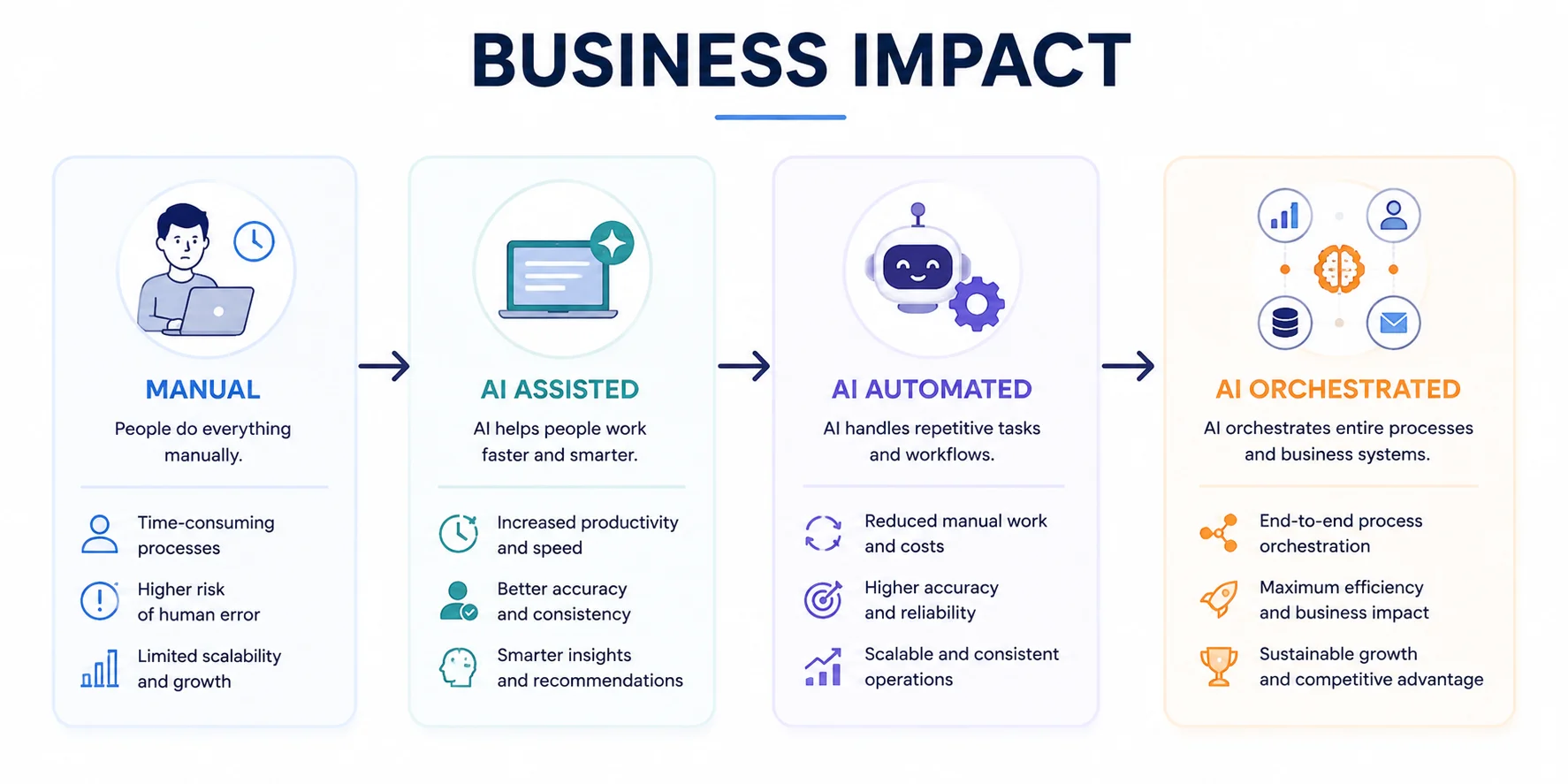
- Choose AI plugins if you need to improve content creation, SEO, or add simple AI functionality to your website.
- Choose custom AI development if AI needs to work with your business data, automate workflows, integrate with multiple systems, or support complex decision-making.
- Choose AI agents when your goal is to automate complete business processes rather than individual tasks.
For many organizations, the most successful strategy is incremental. They begin with simple AI tools, identify high-impact use cases, and gradually expand into custom AI solutions as their needs evolve.
Key takeaway: Successful AI adoption isn’t about implementing the most advanced technology — it’s about solving the right business problems at the right time.
Best Practices for Implementing AI
Successful AI projects rarely begin with technology.
They begin with clearly defined business goals.
Organizations that achieve the best results don’t ask, “How can we use AI?” Instead, they ask, “Which business problem should AI solve first?”
Based on our experience with AI integrations and complex web platforms, several principles consistently lead to successful implementations.
Start with High-Impact Use Cases
Focus on repetitive, time-consuming processes that already have clear workflows. Customer support, content operations, semantic search, and internal knowledge management often deliver measurable value quickly because they combine structured information with repeatable tasks.
Build Around Business Knowledge
The effectiveness of AI depends on the quality of the information it can access.
For simple content generation, public language models may be sufficient. But when AI supports customers or internal teams, it should retrieve answers from trusted business sources such as documentation, product catalogs, policies, and internal knowledge bases.
Keep Humans in the Loop
AI performs best when it augments human expertise rather than replacing it.
Content should be reviewed before publication, business-critical decisions should remain under human control, and customer conversations should be escalated whenever confidence is low or additional judgment is required.
Think Beyond the Website
Many of the highest-value AI projects extend far beyond WordPress.
Connecting AI with CRM platforms, ERP systems, customer support software, analytics, and proprietary business applications creates automation that improves efficiency across the entire organization.
Key takeaway: The most successful AI implementations solve business problems first and use technology as the enabler — not the starting point.
The Future of AI for WordPress
Artificial intelligence is rapidly becoming part of the modern web stack rather than a standalone feature.
Over the next few years, businesses are likely to rely less on isolated AI tools and more on connected AI systems that can understand context, access trusted business information, and automate complete workflows.
For WordPress websites, this means moving beyond content generation toward intelligent customer experiences, semantic search, personalized recommendations, workflow automation, and AI agents that interact with business systems.
At the same time, the role of WordPress remains unchanged.
It continues to provide the flexibility, content management capabilities, and integration ecosystem that businesses depend on. AI simply expands what the platform can do.
Organizations that invest in scalable AI architecture today will be better positioned to adopt future language models, automation technologies, and AI-powered business workflows without rebuilding their digital platforms from scratch.
Frequently Asked Questions
What is AI for WordPress?
AI for WordPress refers to using artificial intelligence to improve how WordPress websites create content, support customers, automate workflows, enhance search, and integrate with business systems. It can range from simple AI plugins to fully customized AI solutions.
Can AI be integrated into an existing WordPress website?
Yes. In most cases, AI can be integrated into an existing WordPress website without rebuilding the platform. Depending on the project, AI may connect through plugins, APIs, custom development, or integrations with external services.
Are AI plugins enough for most businesses?
AI plugins are a great starting point for content generation, SEO assistance, and basic automation. Businesses with more complex requirements — such as customer support, proprietary knowledge, or workflow automation — often benefit from custom AI development that integrates with existing systems.
What’s the difference between AI plugins and AI agents?
AI plugins usually provide predefined functionality, such as generating content or adding chatbot features.
AI agents go further by retrieving business information, interacting with external systems, following business rules, and completing multi-step workflows.
Can AI improve WooCommerce stores?
Yes. AI can enhance WooCommerce with intelligent product recommendations, semantic search, personalized shopping experiences, automated customer support, inventory assistance, and marketing automation.
Is AI replacing WordPress developers?
No.
AI accelerates development and automates repetitive tasks, but successful projects still require developers to design system architecture, integrate business platforms, ensure security, and build custom functionality that aligns with business goals.
How do you know when it’s time for custom AI development?
A good indicator is when AI needs to work with your own business data rather than public information.
If you need AI to interact with CRM systems, internal documentation, product databases, customer support platforms, or proprietary workflows, custom AI development typically delivers more value than standalone tools.
Conclusion
Artificial intelligence is changing how businesses build, manage, and scale digital experiences, but successful AI adoption isn’t about implementing the latest technology.
It’s about solving real business challenges.
For many organizations, the journey begins with simple AI tools that improve productivity. As business needs evolve, AI expands into customer support, workflow automation, intelligent search, and custom AI agents that become part of everyday operations.
WordPress provides an ideal foundation for this evolution thanks to its flexibility, mature ecosystem, and ability to integrate with virtually any business platform.
Whether you’re exploring AI for the first time or planning more advanced automation, the most effective solutions are built around your business — not around the technology itself.
-
 WordPress Development
 How to Handle WordPress Development Overflow Without Hiring
Learn how to handle WordPress development overflow, add flexible capacity, and take on more projects without rushing into a full-time hire.
05.08.2026 -
Business Analysis Insights
HubSpot CRM Integration in 2026: Architecture, Real Examples and Best Practices
Connecting HubSpot to another system is usually not the hardest part. Building a reliable data flow between your website, CRM, ERP, ecommerce platform, internal databases and automation tools is a ...
05.08.2026 -
Performance & SEO
AI-Ready WordPress Architecture: How to Prepare Your Website for AI Search
Search is changing. People are no longer relying only on short keyword queries to find information. They increasingly ask complex questions, compare solutions, and use AI-powered search experiences...
05.08.2026