
Headless WordPress for Enterprise: When to Go Headless for Scale, Speed, and Security
WordPress Development


Enterprise websites are no longer simple marketing pages. They are digital platforms that need to handle high traffic, complex content structures, custom integrations, and constant change without becoming fragile.
That is where headless WordPress for enterprise becomes a strategic decision, not just a technical one. For many growing organizations, Headless WordPress is the architecture that unlocks better performance, more flexibility, and stronger long term scalability.
In this article, we will look at when Headless WordPress makes sense inside enterprise wordpress development, what benefits it can bring, and what needs to be done correctly for SEO, UX, and security.
What Makes WordPress Enterprise Ready
WordPress started as a blogging platform, but it now powers large media brands, universities, global companies, and content heavy platforms that need enterprise grade capabilities.
When it is properly engineered, WordPress offers the flexibility enterprise teams need. It supports custom content types, advanced fields, multisite networks, APIs for integrations, and a mature ecosystem that can adapt to complex business requirements.
A well built enterprise WordPress platform usually has four things in common. It performs well under load, it has strong security and access control, its architecture is modular, and it can deliver content across multiple channels.
The biggest difference between a standard site and true headless WordPress for enterprise is the mindset behind it. Enterprise work treats the site like a product. It is planned, documented, tested, and designed to evolve. That is much more effective than adding plugin after plugin as the project grows.
If a business needs country specific microsites, CRM integrations, approval workflows, or content operations across several teams, then the architecture must support that reality from the start.
When Headless WordPress Is Worth It
Headless WordPress means using WordPress only as the content layer while the front end is built separately with tools like React or Next.js. Content is delivered through APIs, and the presentation layer is fully controlled by the development team.
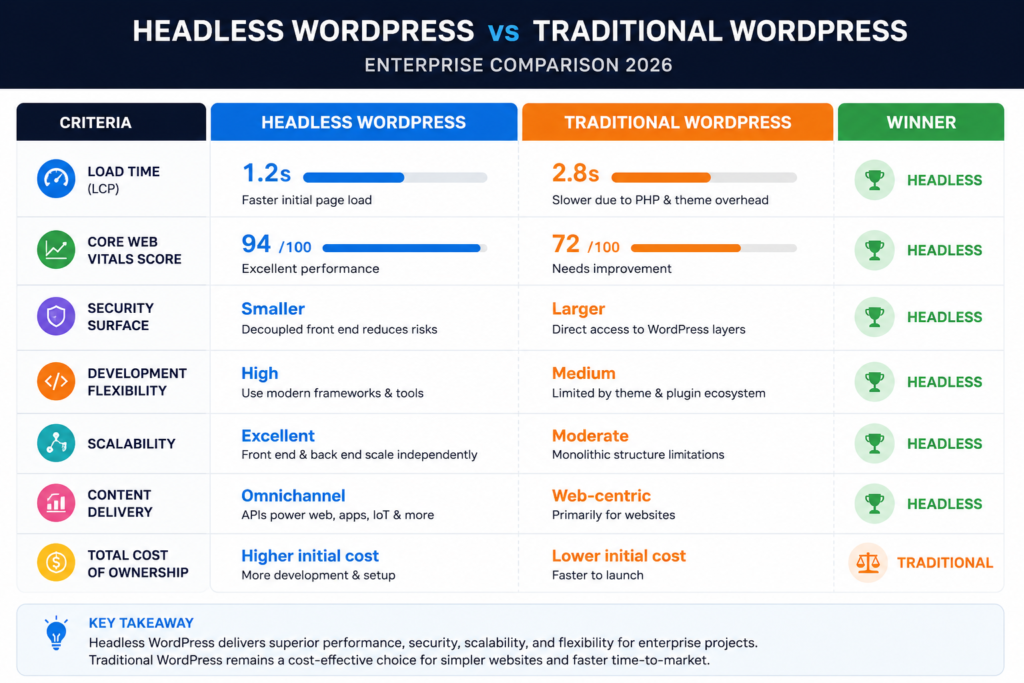
This separation can significantly improve flexibility and performance. In DreamDev’s research, a headless setup loaded much faster than a traditional WordPress build, which is exactly why many enterprise teams start to consider it.
Headless is a strong choice when the project needs a highly custom front end, when one content source must feed multiple platforms, when every second of performance matters, or when the frontend and backend teams need to release independently.
A fast moving enterprise may also benefit from headless when it needs strong branding freedom, interactive experiences, or a content model that serves web, mobile, and internal tools at the same time.
At the same time, not every site needs headless. If the project is simple, if editors need a familiar WordPress workflow, or if the real problem is weak content rather than platform architecture, then a well built traditional setup may be the better option.
A useful rule is simple. Use headless when custom front end behavior, multi channel delivery, or performance at scale is critical. Use traditional WordPress when speed to launch, editorial simplicity, and lower complexity matter more.
For teams that are still improving an existing setup, DreamDev’s WordPress Speed Optimization services can often solve major bottlenecks without introducing unnecessary complexity.
Enterprise WordPress Development 2026
Performance and Core Web Vitals
Performance is not a cosmetic issue. It affects engagement, rankings, and revenue.
Google’s Core Web Vitals are a strong signal of how real users experience a site, and enterprise platforms cannot afford slow load times or unstable layouts. In headless builds, performance often improves because the front end is lighter, rendering is more controlled, and unnecessary WordPress theme overhead is removed.
That is one of the most important advantages in headless WordPress for enterprise. A faster site is easier to use, easier to crawl, and more likely to convert.
Headless WordPress is especially effective when paired with server side rendering or static generation. These methods allow search engines to receive fully rendered HTML while visitors still benefit from a fast modern experience.
To get the best results, the front end should be carefully optimized. Images need compression and modern formats. JavaScript bundles should stay lean. Caching and CDN delivery should be part of the architecture. Every page should still have proper title tags, metadata, and semantic structure.
When these pieces are in place, headless can create a major performance advantage for enterprise sites that depend on speed.
SEO and UX Considerations
Headless architecture gives teams more design freedom, but SEO still needs to be protected carefully.
The main risk is rendering. If important content is loaded only in the browser and search engines cannot reliably access it, rankings can suffer. That is why server side rendering, static generation, clean URLs, and crawlable links matter so much.
Metadata should be unique on every page. Canonical tags need to be correct. Structured data should be added on the server side whenever possible. Internal links should remain visible in the HTML and not depend only on client side navigation.
UX matters too. A headless site can look and feel excellent, but the content structure still needs to be clear. Headings, navigation, readability, mobile behavior, and accessibility all influence both SEO and conversions.
Headless WordPress can be excellent for SEO, but only when it is implemented properly. That is why the front end should be built with search visibility in mind from the beginning, not patched later.
DreamDev’s own headless content already reflects this approach, especially in its guidance around rendering, metadata, canonical tags, structured data, and internal links.
Security, Multisite, and Integration
Enterprise platforms often manage sensitive data, multiple teams, and several markets at once. That means security and integration are not optional.
A strong enterprise setup should include role based access, two factor login, secure deployments, staging environments, code review, and careful plugin selection. In a headless setup, the separation between the content layer and the frontend can also reduce exposure because the public experience is no longer tightly tied to the WordPress admin interface.
For companies managing several regions or brands, WordPress Multisite can be a very practical solution. It allows centralized governance while still supporting multiple websites or business units.
Enterprise projects also need reliable integrations with CRM systems, ERP platforms, marketing automation tools, and internal services. Headless architecture can make this easier because the front end and backend can communicate through APIs in a cleaner way.
DreamDev’s Business Analysis for WordPress approach is especially useful here because it helps define content structure, technical constraints, integrations, and performance expectations before development starts.
Cost, ROI, and the Decision Framework
It is important to be honest about the tradeoff. Headless WordPress usually costs more than a standard build because you are effectively creating two systems, one for content and one for presentation.
That higher investment can still make sense when performance has a direct business impact. If a slow site loses sales, reduces leads, or hurts user engagement, then faster delivery can generate a strong return.
A practical decision framework is this.
Choose headless when the project needs advanced frontend behavior, multiple content destinations, a highly technical team, or serious performance gains.
Choose traditional WordPress when the site needs to launch quickly, editorial simplicity is the priority, or the main issues can be solved through optimization, caching, CDN delivery, and better content structure.
Even when headless is not the right choice, enterprise thinking still matters. The site should be planned carefully, measured properly, and built to support growth.
Why Partner with DreamDev
DreamDev works with complex WordPress projects that need more than a standard theme and plugin setup. That includes custom architecture, headless implementation, performance optimization, and ongoing support.
The value comes from combining strategy with engineering. A strong solution starts with the right architecture, then moves into clean implementation, testing, and continuous improvement.
If your platform needs custom workflows, API integrations, multisite management, or performance work, DreamDev’s Custom and Complex WordPress Development services are built for that kind of challenge.
For teams that need broader support, WordPress Agency Support can help cover architecture, execution, and long term stability.
And when a project needs faster delivery, dev sprint services can help teams resolve bottlenecks and move forward without unnecessary delays.
Conclusion
Headless WordPress is not a trend for every project. It is a powerful option for the right enterprise use case.
In headless WordPress for enterprise, the real question is not whether headless looks modern. The real question is whether the architecture matches the business goals.
If scale, speed, security, and flexibility are critical, headless WordPress can be an excellent choice. If simplicity and speed to launch matter more, traditional WordPress may still be the smarter path.
The best enterprise platforms are not the most complicated ones. They are the ones built with the right structure from the beginning.
FAQ
Is headless WordPress good for SEO?
Yes, when it is implemented correctly with server side rendering or static generation, clean URLs, proper metadata, and crawlable internal links.
Is headless WordPress more expensive?
Usually yes, because it requires a separate frontend build and more technical maintenance. The cost can still be worth it when performance or complexity justifies the investment.
When should an enterprise choose traditional WordPress instead?
When the site needs to launch quickly, content editing simplicity matters most, or the performance issue can be fixed through optimization rather than a full architectural change.
How do I start the right way?
Begin with a business analysis (DreamDev can help) to clarify goals and constraints. From there, we’ll recommend the right architecture. Explore our Custom and Complex WordPress Development service for a structured plan, or simply Contact us for a project discussion.
-
 WordPress Development
 What Happens After a WordPress Website Goes Live? The Work Nobody Plans For
From CRM integrations and plugin updates to technical debt and new business requirements, discover the work that keeps a growing WordPress website moving after launch.
06.05.2026 -
WordPress Development
Taking Over an Existing WordPress Website: A Technical Guide for Agencies
Taking over an existing WordPress website? This technical guide helps agencies assess infrastructure, code, security, integrations, SEO, performance, and technical risks before accepting responsibi...
06.05.2026 -
WordPress Development
How to Handle WordPress Development Overflow Without Hiring
Learn how to handle WordPress development overflow, add flexible capacity, and take on more projects without rushing into a full-time hire.
06.05.2026